Thursday, March 9, 2017

Witr prayer

Praise be to Allaah. 


Witr prayer is one of the greatest acts of worship that draw one closer to Allaah which the Muslim should observe regularly and not neglect. 


 The Prophet (peace and blessings of Allaah be upon him) said: “Allaah has prescribed for you a prayer (by which He may increase your reward), which is Witr; Allaah has enjoined it for you during the time between ‘Isha’ prayer until dawn begins.” 

(Narrated by al-Tirmidhi, 425; classed as saheeh by al-Albaani in Saheeh al-Tirmidhi.) 


The Messenger of Allaah (peace and blessings of Allaah be upon him) said: “Whoever fears that he will not get up at the end of the night, let him pray Witr at the beginning of the night, but whoever thinks that he will be able to get up at the end of the night, let him pray Witr at the end of the night, for prayer at the end of the night is witnessed (by the angels) and that is better.”

( Narrated by Muslim, 755.)


The minimum number of rak’ahs for Witr is one rak’ah, because the Prophet (peace and blessings of Allaah be upon him) said: “Witr is one rak'ah at the end of the night.” 

(Narrated by Muslim, 752.) 


 And he (peace and blessings of Allaah be upon him) said: “The night prayers are two (rak’ahs) by two, but if one of you fears that dawn is about to break, let him pray one rak’ah to make what he has prayed odd-numbered.” 

(Narrated by al-Bukhaari, 911; Muslim, 749.)


 If a person limits himself to praying one rak’ah, then he has performed the Sunnah. But Witr may also be three or five or seven or nine.


 Excerpt from : Islam Question And Answer

Monday, February 6, 2017

Dhuha

In the name of Allah the Most Gracious the Most Merciful

All praise is due to Allah alone. And prayers and peace of Allah be upon the last Prophet S.A.W.

It is narrated on the authority of Abu Dharr (may Allah be pleased with him) that the Messenger of Allah (prayers and peace of Allah be upon him) said:

“In the morning charity is due for every bone in the body of every one of you. Every utterance of Allah's glorification (SubhanAllah) is an act of charity. Every utterance of praise of Him (Alhamdulillāh) is an act of charity, every utterance of profession of His Oneness(La Ilaha Illa Allah) is an act of charity, every utterance of profession of His Greatness (Allahu Akbar) is an act of charity, enjoining good is an act of charity, forbidding what is evil is an act of charity, and two Rak’as which one prays in the forenoon will suffice.”
[Reported by Muslim]


And it is narrated on the authority of Buraida (may Allah be pleased with him) that he heard the Messenger of Allah (prayers and peace of Allah be upon him) says:

“Everyone has three hundred and sixty joints, so he has to give charity for each one of them.” It was said (to him): “O Messenger of Allah, who can afford that?” “You can bury the mucus that you may find in the Masjid, or remove stumbling block from people's path. If you could not afford that, then two Rak’as at Ad-Duha (forenoon) are enough” The prophet s.a.w replied.

[Reported by Ahmad and Abu Dawûd and Authenticated by Al-Albani]


It is an optional prayer that is performed between the full rising of the sun (15 to 20 minutes after sunrise) until it ends approximately 15 minutes before Dhuhr prayer.

And it is better to pray it when the heat of the sun reaches its highest grades, because the Prophet s.a.w says:

“The prayer of those who are penitent is observed when your weaned camels feel the heat of the sun.”

[Reported by Muslim]


The ruling is that Duha prayer is a sunnah mu’akkadah (confirmed Sunnah), which entails massive rewards and blessings if established, but there is no sin on the one who leaves it.


The minimum of Duha prayer rak'ahs is two rak'ahs, because of the saying of Abu Hurayra: “My companion (prayers and peace of Allah be upon him) has advised me to do three things” and mentioned among them “Two Rak’as of Duha prayer.”


And it is said that there is no maximum number of Rak’as for it, because ‘A`ishah (may Allah be pleased with her) said: “The Messenger of Allah (prayers and peace of Allah be upon him) used to pray Duha prayer four Rak’as and then increases as Allah wills.” [Reported by Muslim]


There is nothing clearly authentic narrated about the sūrah to read after surah al-Fātihah. The Shāfiʿi opinion is to recite surah al-Kāfiruun in the first rakʿah and surah al-Ikhlās in the second rakʿah, due to the massive rewards of reciting both surah.


Sayyidina Abu Hurayra (Allah have mercy on him) narrates that my beloved companion (the Messenger of Allah, prayers and peace of Allah be upon him) advised me three things: To fast three days of every month, to perform the two rak'ahs of Dhuha, and that I perform my Witr before retiring to bed.(Sahih al-Bukhari: no: 1981)


****************************

Note to self : May Allah SWT grant us the chance to pray Dhuha habitually, give us HIS blessings and protection always...aamiin.


Saturday, April 5, 2014

Salaat Times, Numbers of Rakats, and Some Suggestions


(Source : sufism.org )


Fajr: From dawn to just before sunrise.

Zuhr: Just after noon (when the sun has passed the median point in the sky).

Asr: Halfway between noon and sunset.

Maghrib: Just after sunset.

Isha: Dark night (approximately an hour and a half after sunset up to Fajr prayer).


The first two rakats of the Fajr and the Maghrib prayers are spoken aloud.


The fard (obligatory) are the required number of rakats.

Additional rakats are often said the sunnah are after the example of the Prophet Muhammad (peace and blessings upon him) and are said individually that is, not in congregation.


The following is a chart of the order and number of rakats for each time of prayer:


* In the third rakat of the Witr prayer, the Fatiha is followed by recitation of a portion of the Qur’an and then the Qunut.


Suggestions

Minimize distractions.

Concentrate on the meaning of the prayers.

Pronounce so that you alone can hear yourself.

Hold a position until you are at rest in it.

Pause long enough to say Subhanallah (God is Pure).

Prescribed prayers should be made in Arabic; personal prayers may be made in one’s own language in any posture during Salaat, especially prostration.

If prayer is missed unavoidably, it may be said after its time has passed.

Wednesday, February 5, 2014

Sujood

**************************


The more you humble yourself and go into sujood, the closer you are getting to Allah; and indeed, He elevates you.


The Prophet ﷺ said:

من تواضع لله رفعه


“Whoever humbles himself before Allah, Allah will elevate him.” (Muslim)


The Prophet ﷺ said:

إن أمتي يومئذ غر من السجود محجلون من الوضوء

“My ummah on that day will surely have bright faces because of sujood, and bright arms and feet because of ablution.” (Ahmad)


It has been narrated that when the son of Adam recites the verse of Sajdah (prostration) and then falls down in prostration, Satan goes into seclusion and weeps and says: “Woe unto me, the son of Adam was commanded to prostrate, and he prostrated and Paradise was entitled to him and I was commanded to prostrate, but I refused and am doomed to Hell.” (Muslim)


**********************

Tuesday, July 9, 2013

Taraweeh

MARHABAN YA RAMADHAN


Taraweeh is derived from the Arabic root word, raaha, which means to rest, relax and use as recreation. It is so called because the believers used to prolong it. After every four raka'ats they would stop for rest and relaxation and resume until taraweeh was complete.


'Aishah (raa) has been reported as saying:

"The Messenger of Allah (saas) observed Taraweeh prayer in the Masjid one night and people prayed with him. He repeated the following night and the number of participants grew. The companions congregated the third and fourth night, but the Messenger did not show up. In the morning he told them, "I saw what you did last night, but nothing prevented me from joining you except my fear that it might be made mandatory on you in Ramadan."

(Bukhari and Muslim)


No one should neglect Taraweeh without a good reason, for it is part of physical and spiritual training, for its observation soon after Iftar insures timely and proper digestion of food. Besides, there are spiritual rewards awaiting the observers of this prayer. No one would like to leave the Masjid before the prayer is over.


Everybody should attend the Masjid prayers, including women, provided they are properly covered.

The Messenger of Allah said: "Prevent not the women servants of Allah, from going to the Masjid of Allah."

However, when they attend the Masjid they should wear no perfume, nor raise their voices, and or show their beauty.

Allah (SWT) states: "...they should not display their beauty and ornaments except what (must ordinarily) appear thereof..." (Al-Qur'an, 24:31)


[excerpt from : TARAWEEH (link here)]

Monday, October 22, 2012

Eid-ul-Adha 1433H

***********************


At the Ka’bah
(extract from Ibn AlQayyim's poem on Hajj)


When they see His House - that magnificent sight
For which the hearts of all creatures are set alight -

It seems they’ve never felt tired before,
For their discomfort and hardship is no more.

Now the eye of the Lover drowns in its streams,
It sees through its tears the goal of its dreams;

Now for Allah, how many tears are issued,
Each one being followed by a multitude?

When the eye perceives the House, its darkness clears,
And from the sorrowful heart, pain disappears;

Vision cannot encompass this beautiful sight:
Each glance returns with greater delight!

No wonder at this, for when the Merciful preferred
The House for Himself, it became most honoured.

He clothed it in Majesty, a magnificent garment;
Embroidered it with Beauty, a wonderful ornament!

The hearts all love the House therefore,
Awed and humbled, in respect and honour.


Saturday, August 18, 2012

Wednesday, April 25, 2012

Missed Appointments


Found this poem (here)..a timely  reminder to me....

*****************


YOU show more concern for me than any doctor, I must say
Cos You want to see me so many times in just one day

Afterall – it’s You who looks after the health of the soul
Something that the most learned specialist in the world can only ever dream to control

I spiff up in my best for every job interview
So why procrastinate to purify myself for my meeting with You
Afterall – they are interviews into Jannah, true?

What about meeting the queen or a celebrity singing tween?
Definitley count me in!

I can go to a pro to sort out the stuff I don’t like about me :

* Personal Trainer
* Beautician
* Dietician
* Debt Councillor
* Even a Shrink

…At a nominal fee

Every cent worth it … really?

But

Why is it so difficult for me to pour out all my


~ sorrows,
~ pains,
~ dreams

and

~ hopes to You

Afterall – it is for free?

And

Should I happen to miss

* a train,
* plane,
* party,
* an appointment,
* movie date

How would I feel?
Definitely more than a smidge irate,

Miss a fixed appointment with You?
With a set time, date, place?
What a disgrace!

Forgive me for standing You up so many times!
Surely this must be the worst of crimes

Considering it’s me that needs You
even though sometimes I am so short sighted this I can’t even see

By now even my own blood would have given up on me

But

You just keep bestowing blessings on me!

Ya Ghafuru,

Please hold on to me!

********************


Thursday, February 16, 2012

Levels of prayer


Ibn al-Qayyim (may Allah have mercy on him) said,

"And mankind, with regard to their performance of prayer are in five levels."


The First:

The level of the one who is negligent and wrongs his soul. He is the one who falls short in performing ablution properly, performing the prayer upon its time and within its specified limits, and in fulfilling its essential pillars.


The Second:

The one who guards his prayers upon their proper times and within their specified limits, fulfills their essential pillars and performs his ablution with care.

However, his striving is wasted due to whisperings in his prayer so he is taken away by thoughts and ideas.


The Third:

The one who guards his prayers within the specified limits, fulfills their essential pillars and strives with himself to repel the whisperings, thoughts and ideas.

He is busy struggling against his enemy (Shaitan) so that he does not steal from the prayer. On account of this he is engaged in (both) prayer and jihad.


The Fourth:

The one who stands for the prayer, completes and perfects its due rights, its essential pillars, performs it within its specified limits and his heart becomes engrossed in safeguarding its rights and specified limits, so that nothing is wasted from it.

His whole concern is directed towards its establishment, its completion and its perfection, as it should be. His heart is immersed in the prayer and in enslavement to his Lord, the Exalted.


The Fifth:

The one who stands for the prayer like the one mentioned above. However, on top of this, he has taken and placed his heart in front of his Lord, the Mighty and Majestic, looking towards Him with his heart with anticipation, (his heart) filled with His love and His might, as if he sees and witnesses Allah.

The whisperings, thoughts and ideas have vanished and the coverings which are between him and his Lord are raised. What is between this person and others with respect to the prayer, is superior and greater than what is between the heavens and the earth.

This person is busy with his Lord, the Mighty and Majestic, delighted with Him.


The first type will be punished;
the second type will be held to account;
the third will have his sins and shortcomings expiated;
the fourth will be rewarded;

the fifth will be close to his Lord,
 because he will receive the portion of the one 
who makes his prayer the delight and pleasure of his eye.


Whoever makes his prayer the delight and pleasure of his eye, will have the nearness to his Lord, the Mighty and Majestic, made the delight and pleasure of his eye in the hereafter.

He will also be made a pleasure to the eye in this world since whoever makes Allah the pleasure of his eye in this world, every other eye will become delighted and pleased with him.


(From my mailbox)

Thursday, February 9, 2012

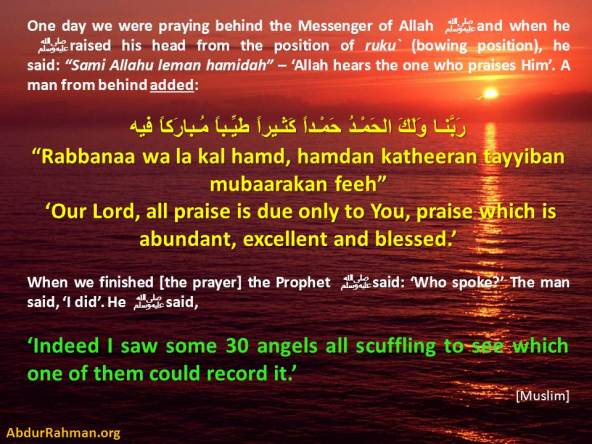
I'tidal اعتدال

Sesudah selesai melakukan rukuk diteruskan dengan I`tidal iaitu bangkit berdiri tegak dengan mengangkat kedua tangan sampai ke telinga dengan jari-jari terbuka seperti ketika TAKBIRATULIHRAM seraya membaca TASMI’.


(After completion of the bow do I`tidal namely stood upright with both hands lifted to the ear with the fingers open just like when TAKBIRATULIHRAM while reading TASMI.)


Ketika berdiri tegak, mata tetap ditujukan ke arah sujud .(tempat sujud)

(When standing upright, the eyes must still be directed towards the prostrate. (Place of prostration))


Monday, October 10, 2011

Offering a Two Rak'ah Prayer After Tawaf

It is sunnah to offer a two rak'ah prayer after completing the tawaf at the Station of Ibrahim (peace be upon him), or at any other place in the Sacred Mosque, regardless of whether it is a supererogatory tawaf or obligatory one (as in Hajj or 'Umrah).

Jabir reported that "When the Prophet (peace be upon him) came to Makkah, he went around the Ka'bah seven times, then went to the Station of Ibrahim and recited the verse (Qur'an 2.125): "And take of the Station of Abraham a place of prayer." He prayed behind it, and then went to the Black Stone and kissed it." (Reported by Tirmizhi who considers it a sound hadith)

In this two rak'ah prayer, it is sunnah to recite Surah Al-Kafirun, in the first rak 'ah, and Surah Al-Ikhlas in the second rak 'ah, after reciting Al-Fatihah. (Reported by Muslim and others) These two rak'ahs may be offered at any time of the day and night including the prohibited times.

Jubair bin Mut'im reported that the Prophet (peace be upon him) said, "O Bani Abd Manaf! Do not prevent anyone from performing tawaf around the Ka'bah. One may pray (in the Sacred Mosque) any time during the day or night." (Reported by Ahmad, Abu Dawud, and Tirmizhi who regards it a sound hadith) Ash-Shafi'i and Ahmad hold this view.

Though it is sunnah to offer this two rak'ah prayer after the tawaf in the Sacred Mosque, it may also be offered outside the Mosque. Umm Salamah reported that she performed a tawaf around the House riding, but she did not offer the two rak'ah prayer until she had left the Mosque. (Bukhari) Malik reported from 'Umar that he offered these two rak'ahs at Zhi Tuwa valley. Bukhari also has reported that 'Umar prayed (these two rak'ahs) outside the Sacred Mosque.

If one offered a prescribed prayer after the tawaf then he need not offer this two rak'ah prayer. The Shafi'i school holds this view, which is also in accordance with the well known position of Ahmad. The Maliki and the Hanafi schools are of the opinion that these two rak'ahs must be offered and no other prayer can replace them.


Fiqh-us-Sunnah (here)

Friday, August 5, 2011

Du’aa of Istikhaarah


(youtube by ummsuhayb : here )


Beautifully recited by Mishary Raashid al-'Afasy.

Here is the Arabic of the du'aa:

اللهم إني أستخيرك بعلمك ، واستقدرك بقدرتك ، وأسألك من فضلك العظيم ، فإنك تقدر ولا أقدر ، وتعلم ولا أعلم ، وأنت علام الغيوب . اللهم إن كنت تعلم أن هذا الأمر- ويسمي حاجته - خير لي في ديني ومعاشي وعاقبة أمري فاقدره لي ، ويسره لي ، ثم بارك لي فيه . وإن كنت تعلم أن هذا الأمر شر لي في ديني ومعاشي وعاقبة أمري فاصرفه عني واصرفني عنه واقدر لي الخير حيث كان ثم أرضني به

----

Here is the English Transliteration of the du'aa:

[Allaahumma innee astakheeruka bi'ilmik, wa astaqdiruka biqudratik, wa as aluka min fadlikal 'atheem, fa innaka taqdiru wa laa aqdir, wa ta'lamu wa laa a'lam, wa anta 'allaamul ghuyoob. Allaahumma in kunta ta'lamu anna haathal amr. -here you mention your need-. Khayrun lee fee deeni wa ma'aashi wa 'aaqibati amree faqdirhu lee wa yassirhu lee, thumma baarik lee fee. Wa in kunta ta'lamu anna haathal amr sharrun lee fee deenee wa ma'aashi wa 'aaqibati amree fasrifhu annee wasrifni an waqdir li al-khayra haythu kaan thumma ardineebi.]

----

And here is the English meaning:

O Allaah, I seek Your counsel by Your knowledge and by Your power I seek strength and I ask You from Your immense favour, for verily You are able while I am not and verily You know while I do not and You are the Knower of the unseen. O Allaah, if You know this affair -and here he mentions his need- to be good for me in relation to my religion, my life, and end, then decree and facilitate it for me, and bless me with it, and if You know this affair to be ill for me towards my religion, my life, and end, then remove it from me and remove me from it , and decree for me what is good wherever it be and make me satisfied with such.


****************


Jabir bin Abdullaah –RadhiAllaahu anhu- said 

"the Messenger of Allaah -sallAllaahu alayhi wa sallam- used to teach us al-Istikharah (a prayer said for seeking blessings in carrying out a decision) for all matters, just like he used to teach us a chapter from the Qur’aan, he would say: If any of you intends to undertake a matter then he should pray two Rakah other than an obligatory prayer then he should say the Du'aa of Istikhaarah.


Ibn al-Qayyim -Rahimullaah- said:

‘So the purpose of al-Istikharah is to rely upon Allaah and entrustment to Him and the capability to fulfill the action with Allaah’s Capability, His knowledge. And that Allaah chooses good for His slave, and this is from those things which necessitate being pleased with Allaah as the Lord. As a person will not taste the flavour of Eemaan if he does not have these things (reliance, entrustment etc), and if he is pleased with destiny after al-Istikharah then that is a sign of happiness.’

[Taken from ‘Za’ad al-Ma’aad’ by Ibn al-Qayyim 2/443-445]


Shaykh Muhammad bin Umar Bazmool said:

‘That al-Istikharah is not done when a person is uncertain about the matter at hand; because the Prophet -sallAllaahu alayhi wa sallam- said: ‘If any of you intends to undertake a matter’ and that the whole of the Dua’ indicates to this point.

So if a Muslim is uncertain about a matter, and he intends to pray al-Istikharah , then he should make a choice between the two matters and then pray al-Istikharah , and then after al-Istikharah he executes that matter, and if it was good then Allaah will make it easy for him and bless him in that, and if it was not good for him, then Allaah turns it away from him and makes easy for him that in which there is good by the permission of Allaah -Subhanahu wa Ta’ala.

[Taken from: ‘Buggeeyat al-Mutattawa’ fee salat at-tattawa’ p.105]

Thursday, May 12, 2011

Benefits of Prayers by Ibn Qayyim Jawzyah

In his excellent book, Zaad al-Ma'aad, in the section which includes the book, At-Tibb an-Nabawee, Shaykh al-Islaam Ibn al-Qayyim (may Allaah have Mercy on him) stated in his alphabetized discussion of medicines and nutrition:


Allaah the Exalted has said:

( And seek help in patience and in prayer. Surely that is something quite difficult on (people) other than people of humility and submissiveness )

And HE has said:

( O you who believe! Seek help in patience and in prayer! Verily, Allaah is with those who are patient. )

And HE, the Exalted One, has said:

(And command your family to pray, and be patient upon that. We are not asking you for any provisions,(rather) We provide for you, and the favorable outcome is for (those with) taqwaa (consciousness of Allaah that produces righteous actions). )


And in the Books of Sunnah it is reported that the Messenger of Allaah (sallallaahu 'alayhe wa sallam) used to hasten to prayer whenever an affair disturbed him.


And previously discussed was the concept of healing most ailments through prayer before seeking out other ways of dealing with them.

- 1 - Prayer is something that causes one to receive sustenance.

- 2 - It draws one close to Ar-Rahmaan (Allaah, the Most Merciful).

- 3 - It keeps away the Shaytaan (the Devil).

- 4 - It is something that safeguards one's physical health.

- 5 - It keeps away harmful things.

- 6 - It casts away illnesses.

- 7 - It strengthens the heart.

- 8 - It brightens one's countenance.

- 9 - It delights the soul.

- 10 - It gets rid of laziness.

- 11 - It makes the limbs active.

- 12 - It increases one's physical strength.

- 13 - It expands the chest (making one at ease and giving him insight).

- 14 - It is nourishment for the soul.

- 15 - It illuminates the heart.

- 16 - It safeguards one's blessings.

- 17 - It repels catastrophes.

- 18 - It brings on blessings.


And overall, it has an amazing effect on the health of the body and heart, and in strengthening them and expelling harmful pollutants from them. No two people have been afflicted with any disability, disease, or other calamity, except that the portion of the one who prays is less and his outcome is cleaner.


Also, prayer has an amazing effect on the evils of the dunyaa (the worldly life) and how it repels them, especially when the prayer is performed properly and completely, inwardly and outwardly. Nothing keeps the evils of the dunyaa at bay and brings on the benefits of it like prayer.


The reason behind this is that prayer is one's connection to Allaah, the Mighty and Majestic. So based on the strength of a person's relationship with his Lord, the Mighty and Majestic, the doors of goodness will accordingly be opened up for him, bad things and the reasons for them befalling him will be cut off, and the elements of success granted by His Lord, the Mighty and Majestic, will begin pouring in, along with safety and good health, wealth and worldly riches, relaxation, bliss, enjoyment, and all types of joyful affairs will be brought to him, and in an expedient manner, too.


( Here )

Tuesday, May 10, 2011

Sajdah Tilawah

(From Saudi Gazette - Fatwa)


Q – If I come across a verse in which there is a prostration when I am reciting the Qur’an at my desk, or when I am teaching the students, or at any other place, should I perform Sajdah Tilawah, or not? And is the prostration for the reciter and the listener both?


A – Sajdah Tilawah is a Sunnah for the reciter and for the listener and it is not an obligation, nor is it prescribed for the listener except while following the reciter. So if you recite a verse in which there is a prostration in your office or at the place of instruction, it is lawful for you to make prostration and it is prescribed for the students to prostrate with you, because they are the listeners. And if you do not observe the prostration, there is no objection.

– Sheikh Abdul Aziz Bin Baz; Fatawa Islamiyah, vol. 2, pg. 282

Sajdah at-Tilawah (Arabic: سجدة التلاوة) is a prostration (sujud) that is performed when certain verses of the Qur`an are recited or read. According to Ibn Hazm, performing this protstration is not obligatory (wajib), but is surplus.

For example Zaid bin Thabit related in a hadith that the Prophet did not prostrate when the former read surat an-Najm to him.

Generally, there are fourteen sajdahs in the Qur'an. According to Imam ash-Shafi' the fifteenth verse is in surat al-Hajj 22:77. The ayat of sajdah are marked with the following symbol in the Qur'an: ۩. The fifteen verses of prostration are:

1. al-'Araf 7:206
2. ar-Ra’d 13:15
3. an-Nahl 16:49
4. al-Isra' 17:107
5. Maryam 19:58
6. al-Hajj 22:18
7. al-Hajj 22:77
8. al-Furqan 25:60
9. an-Naml 27:25
10. as-Sajdah 32:15
11. Saad 38:24
12. Fussilat 41:37
13. an-Najm 53:62
14. al-Inshiqaq 84:21
15. al-‘Alaq 96:19

Friday, May 6, 2011

Punctuality of Prayer

Sheikh Abdul Nasir Jangda gives an important reminder about the importance of the five daily prayers. Miraculously, the prayers have the ability to enhance all aspects of our lives (school, work, family, etc.). We should strive to make the prayers an event in our daily schedules, instead of just praying when we get time throughout the day.


(From youtube : Quran Weekly - here)


Here are some tips from Syeikh Abdul Nasir on how to safeguard your prayers:

1. Punctuality.

Treat Solat as a priority. Sometimes we think that we do not get the focus of solat but it is actually because we do not treat solat as number one.

2. Make every Solat an Event.

Abdullah bin Mas’ud had asked the Prophet (PBUH), “Which deed is the dearest to Allah?”

The Prophet (PBUH) replied, “To offer As-Salat (the prayers) at their early stated fixed times.”


3. Treat prayer as a valuable commodity.

Solat is the most valuable asset that we have. It is the basis and foundation of our relationship with Allah. Like a diamond or a hidden pearl in the depths of the ocean, solat is such a valuable asset that we have to protect and safeguard it.

“Guard strictly As-Salat (prayers) especially the middle solat. And stand before Allah with obedience.” – Al-Baqarah, 238

Monday, November 22, 2010

Who passes in front of a praying person...

Abul-Juhaim `Abdullah bin Al-Harith
(May Allah be pleased with him) said:

The Messenger of Allah (Sallallahu Alaihi Wasallam) said,

"If the person who passes in front of a praying person,
realizes the enormity of the sinfulness of this act,
it will have been better for him to wait
forty than to pass in front of him.''

[Al-Bukhari and Muslim].

[The narrator was not sure whether
the Prophet (Sallallahu Alaihi Wasallam) said forty days, months or years.]


Commentary:


We learn from this Hadith that it is a great sin to pass before
a person who is offering Salat. People should also take care that
they do not offer Salat without placing a Sutrah in front of them.
A Sutrah refers to anything that a person sets up in front of him;
this could be a stick, another person praying in front of him or
even a line which he can draw on the ground. The distance between
the person offering his Salat and the Sutrah should not be more
than approximately one meter and a half. If the distance is longer
than this, then it is not unlawful to pass before someone offering Salat.

Wednesday, October 20, 2010

Mistakes Done In Sujud


********************


By: Mashhur Hasan Al Salman


(Source: The Clarified Ruling Of Mistakes Done In Salat)


While being in the State of Sujud, some muslims abandon the Sunnah of Tajafi which is to lift one’s belly up wards away from one’s thighs and one’s arms away from one’s sides as far as possible provided one does not cause inconvenience to the one next to him.


It also includes that one lifts one’s arms from the ground putting only his hands on it at the level of his shoulders or ears not at the knees.


However, a muslim must not exaggerate in doing Tajafi by straightening his back to an extent that he looks like the one lying on the ground. This is indeed a detested exaggeration.(3)


Tajafi must be done in a moderate manner; stretching not one’s back too much nor huddling oneself too much.


Some muslims behave like animals in their Salat the thing that indicates their sense of carelessness towards it.


Some of them may look here and there like a fox does, spread their arms on the ground like lions, do their Salat so quickly in the same manner a crow does when eating, stick to a certain place in which one does his Salat like a camel does regarding his resting place, sit on one’s buttocks spreading one’s feet like dogs do when they sit, or moving one’s hands to the left and to the right when reciting Taslim in the same manner horses move their tails.


Ibn Al-Qayyim said: ‘Our Shari‘ah prohibited that a muslim act in the same manner the Kuffar, animals, demons, bedouins or women [as for men] act. While being in Salat, we [muslims] are also forbidden to act in the same manner animals or the ignorants behave.(4)


’Anas (Radhi Allaahu Anhu) related that the prophet (Sallalahu Alahi wa Sallam) said: ‘Straighten your selves when doing Sujud; never spread your arms on the ground as dogs do’.(5)


Explaining this hadith, Imam An-Nawawi said: ‘The hadith means that when prostrating, a muslim must put his hands on the ground lifting his arms a way from it and totally a way from his sides that his armpits could be seen in case they were uncovered. This manner of doing Sujud is recommended by all ‘Ulamah, if it was abandoned one incurs a sin upon himself but his Salat is valid, Allah (Subhanahu wa Ta'ala) knows best.


The ‘Ulamah stated that the rationale behind such a manner of doing Sujud is to show complete submission [to Allah (Subhanahu wa Ta'ala)] and it gives a sense of activity. On the other hand, spreading one’s arms on the ground -like dogs do when they sit- cast a sense of carelessness towards Salat and not being fully given to it’.(6)


It is of Sunnah that one’s feet be erected in Sujud, heels be close together and toes be directed to the Qiblah.(1) Unfortunately, this Sunnah has been abandoned by many muslims. I hope that these few lines get them to remember it and put it under application. May Allah (Subhanahu wa Ta'ala) guide us to follow his prophet’s (Sallalahu Alahi wa Sallam) Sunnah.


It is also a mistake to put one’s fists on the ground when doing Sujud as some people do and so is the case with putting one feet on the other.


May Allah (Subhanahu wa Ta'ala) guide us and them to the right.


(1) Narrated by Ibn Khuzaimah in his “Sahih” (vol. 1 / p. 322) (no. 638), through a good chain of narrators as is mentioned in “Sifat Salatun Naby” (p. 149).

(2) See: “Sifat Salatun Naby” (p. 149).

(3) See: The article titled “Tanbihat ‘Ala Ba’dil ’Akhta’ Allaty Yaf‘aluha Al-Musallin Fi Salatihim” by shaikh ‘Abdullah Ibn ‘Abdir Rahman Al-Jibrin, published by “Al- Mujtama’ magazine (issue no. 855).

(4) Al-Furusyyah (p. 10). See: “As- Salat wahukmu Tarikiha” (p. 143).

(5) Narrated by Al-Bukhari in his “Sahih” (vol. 2 / p. 301) (no. 822).

(6) “Sahih Muslim” Sharh An-Nawawi, (vol. 4 / p. 209).


Thursday, September 9, 2010

Eid ul Fitr Greetings

Assalamualaikum

To all my Muslim friends :


May the blessings of Allah SWT be with you and famly.

Wednesday, September 8, 2010

Eid Prayer


Short Description of the Eid Prayer and the Eid Khutbah

From Islamic Newsletter 'As-Sunnah' Issue no: 10

Compiled by Sister Shawana A. Aziz


The Messenger of Allah (sallallahu alaihi wa-sallam) said: “Let the free women, the virgins, and the menstruating women attend the Eid prayer, and witness the good and the supplications of the believers. As for the menstruating women, they should stay away from the Musallah (i.e.. should not participate in the prayer itself).”
[Saheeh al-Bukharee and Saheeh Muslim]


Eid ul Fitr Salah (Prayer) - Makkah - 1429 (2008)
صلاة العيد في الحرم المكي


1 - The Eid Salaah consists of two Raka'ahs. Umar (radhi allahu anhu) said: “The traveler’s prayer is two raka'ah; the Adha prayer is two Raka'ah; and the Jumuah prayer is two Rak'ah; this is their full length as came from the Messenger of Allah (sallallahu alaihi wa-sallam).”
[(saheeh) Musnad Ahmad, Nisa'ee, Baihaqee and others]


2 - The Eid Salaah is not preceded by the adhan (the call to announce the prayer time) or Iqamah (the call to start prayer). Jabir bin Samurah (radhi allahu anhu) said: “I prayed the Eid prayer with Allah's Messenger (sallallahu alaihi wa-sallam), on more than one occasion, without adhan or Iqamah.”
[Saheeh Muslim]


3 - No Sunnah prayer may precede or follow the Eid prayer, except if it is performed in a Masjid instead of a Musallah, in which case one must pray two raka'hs before sitting down. Ibn Abbas (radhi allahu anhu) reported: “The Prophet (sallallahu alaihi wa-sallam) went out (of his house) on the day of Fitr, prayed two raka'hs and did not pray before or after it.”
[Zaad al-Maad (2/443)]


4 - Like any other deed in Islam, the prayer must be preceded with a true intention of worshiping Allah alone in the heart.


5 - The first raka'h (one prayer unit) is initiated with Takbeer al-ihram, followed by the opening supplication.


6 - Then followed by seven Takbeers in the first raka'h and five more in the second rak'ah. Aa'ishah (radhi allahu anha) said: “Allah's Messenger (sallallahu alaihi wa-sallam) would say Takbeer in both Fitr and Adha: seven in the first and five in the second, other than the two Takbeers of Ruku (bowing).”
[(Saheeh) - Abu Dawood (1150) and others]


7 - After the Takbeer one should recite Ta'awwuth - 'A'uthu billahi min ash-Shaytaan ir-Rajeem' meaning “I seek refuge in Allah from the outcast devil” and Basmallah 'Bismillah ar-Rahmaan ar-Raheem' meaning 'In the Name of Allah, the Most Beneficent, the Most Merciful.'


8 - Followed by the recitation of Soorah al-Fatihah


9 - Then, the recitation of Soorah al-Qaaf in the first raka'h and the Soorah al-Qamar in the second - OR - Soorah al-Alaa in the first and Soorah al-Ghashiyah in the second.

Ibn al-Qayyim (rahimahullah) said: “Both of these have been authentically reported from the action of the Prophet (sallallahu alaihi wa-sallam), nothing else is authentic.”
[Zaad al-Maad (1/443)]

(Note: Reciting a Soorah different from the ones mentioned above will too complete the prayer.)

The remainder of the prayer is performed in the same manner as any other prayer, without any difference.


Eid-ul-Fitr Salah - Madinah - 1429


The Eid Khutbah:


The Sunnah of the Eid Khutbah is that it should be delivered after the Eid Salaah. Ibn Abbas (radhi allahu anhu) said: “I attended the Eid with Allah's Messenger (sallallahu alaihi wa-sallam), Abu Bakr (radhi allahu anhu) Umar (radhi allahu anhu) and Uthman (radhi allahu anahu); all of them would pray before the Khutbah.”
[Saheeh al-Bukharee]


Listening to the Eid Khutbah is not wajib , Abdullah bin as-Sa'ib (radhi allahu anhu) reported that he attended the Eid prayer with the Prophet (sallallahu alaihi wa-sallam); and when he (sallallahu alaihi wa-sallam) finished the prayer, he said: “We shall have a Khutbah; so let whoever wishes to sit for the Khutbah do so, and whoever wishes to leave, may leave.”
[(saheeh) Abu Dawood)]


If the Eid falls on a Friday, it becomes optional for men to attend the Jumu'ah prayer. Abu Hurayrah (radhi allahu anhu) reported that on such occurrence, the Messenger of Allah (sallallahu alaihi wa-sallam) said: “Two Eids have coincided on this day of yours; thus whoever wishes, is exempted from attending the Jumu'ah prayer. Yet, we shall hold it.”
[Authenticated by Shaikh al-Albanee in Irwa ul-Ghalil]


It should be noted that if one does not attend the Jumu’ah prayer, then it becomes obligatory on him to offer the Dhuhr prayer.

Thursday, September 2, 2010

How to Seek Laylatul-Qadr

By ~ Shaykh Muhammad Nasir-ud-Deen al-Albani

(From Islaam.com)


Adapted from "The Night Prayers: Qiyam & Tarawih from works by Muhammad Nasir ud-Deen al-Albani (and other scholars)"
(Compiled by Muhammad al-Jibali, © 1997 QSS)


Laylat ul-Qadr is the most blessed night.


A person who misses it has indeed missed a great amount of good. If a believing person is zealous to obey his Lord and increase the good deeds in his record, he should strive to encounter this night and to pass it in worship and obedience. If this is facilitated for him, all of his previous sins will be forgiven.


Praying Qiyaam


It is recommended to make a long Qiyaam prayer during the nights on which Laylat ul-Qadr could fall. This is indicated in many hadeeths, such as the following:


Abu Tharr (radhiallahu `anhu) relates:

"We fasted with Allah's Messenger (sallallahu `alayhi wa sallam) in Ramadaan. He did not lead us (in qiyaam) at all until there were seven (nights of Ramadaan) left. Then he stood with us (that night - in prayer) until one third of the night had passed. He did not pray with us on the sixth. On the fifth night, he prayed with us until half of the night had passed. So we said, 'Allah's Messenger! Wouldn't you pray with us the whole night?'

He replied:


'Whoever stands in prayer with the imaam until he (the imaam) concludes the prayer, it is recorded for him that he prayed the whole night.'…"
[Recorded by Ibn Abi Shaybah, Abu Dawud, at-Tirmithi (who authenticated it), an-Nasa'i, Ibn Majah, at-Tahawi (in Sharhu Ma`an il-Athar, Ibn Nasr, al-Faryabi, and al-Bayhaqi. Their isnad is authentic.]


[Point of benefit: Abu Dawud mentioned: "I heard Ahmad being asked, 'Do you like for a man to pray with the people or by himself during Ramadan?' He replied, 'Pray with the people' I also heard him say, 'I would prefer for one to pray (qiyaam) with the imaam and to pray witr with him as well, for the Prophet (sallallahu `alayhi wa sallam) said: "When a man prays with the imaam until he concludes, it is recorded that he prayed the rest of that night." [Masaa'il]]


Abu Hurayrah (radhiallahu `anhu) narrated that the Messenger (sallallahu `alayhi wa sallam) said:

"Whoever stands (in qiyaam) in Laylat ul-Qadr [and it is facilitated for him] out of faith and expectation (of Allah's reward), will have all of his previous sins forgiven."
[Al-Bukhari and Muslim; the addition "and it is facilitated for him" is recorded by Ahmad from the report of `Ubaadah Bin as-Samit; it means that he is permitted to be among the sincere worshippers during that blessed night.]


Making Supplications


It is also recommended to make extensive supplication on this night. `A'ishah (radhiallahu `anha) reported that she asked Allah's Messenger (sallallahu `alayhi wa sallam), "O Messenger of Allah! If I knew which night is Laylat ul-Qadr, what should I say during it?"

And he instructed her to say:

"Allahumma innaka `afuwwun tuh.ibbul `afwa fa`fu `annee - O Allah! You are forgiving, and you love forgiveness. So forgive me."
[Recorded by Ahmad, Ibn Majah, and at-Tirmithi. Verified to be authentic by Al-Albani]


Abandoning Worldly Pleasures for the Sake of Worship


It is further recommended to spend more time in worship during the nights on which Laylat ul-Qadr is likely to be. This calls for abandoning many worldly pleasures in order to secure the time and thoughts solely for worshipping Allah.


`A'ishah (radhiallahu `anha) reported:


"When the (last) ten started, the Prophet (sallallahu `alayhi wa sallam) would tighten his izaar (i.e. he stayed away from his wives in order to have more time for worship), spend the whole night awake (in prayer), and wake up his family."
[Al-Bukhari and Muslim]


And she said:

"Allah's Messenger (sallallahu `alayhi wa sallam) used to exert more (in worship) on the last ten than on other nights."
[Muslim ]

Popular Posts

LinkWithin

Related Posts with Thumbnails

cbox