In the name of Allah the Most Gracious the Most Merciful
All praise is due to Allah alone. And prayers and peace of Allah be upon the last Prophet S.A.W.
It is narrated on the authority of Abu Dharr (may Allah be pleased with him) that the Messenger of Allah (prayers and peace of Allah be upon him) said:
“In the morning charity is due for every bone in the body of every one of you. Every utterance of Allah's glorification (SubhanAllah) is an act of charity. Every utterance of praise of Him (Alhamdulillāh) is an act of charity, every utterance of profession of His Oneness(La Ilaha Illa Allah) is an act of charity, every utterance of profession of His Greatness (Allahu Akbar) is an act of charity, enjoining good is an act of charity, forbidding what is evil is an act of charity, and two Rak’as which one prays in the forenoon will suffice.”
[Reported by Muslim]
And it is narrated on the authority of Buraida (may Allah be pleased with him) that he heard the Messenger of Allah (prayers and peace of Allah be upon him) says:
“Everyone has three hundred and sixty joints, so he has to give charity for each one of them.” It was said (to him): “O Messenger of Allah, who can afford that?” “You can bury the mucus that you may find in the Masjid, or remove stumbling block from people's path. If you could not afford that, then two Rak’as at Ad-Duha (forenoon) are enough” The prophet s.a.w replied.
[Reported by Ahmad and Abu Dawûd and Authenticated by Al-Albani]
It is an optional prayer that is performed between the full rising of the sun (15 to 20 minutes after sunrise) until it ends approximately 15 minutes before Dhuhr prayer.
And it is better to pray it when the heat of the sun reaches its highest grades, because the Prophet s.a.w says:
“The prayer of those who are penitent is observed when your weaned camels feel the heat of the sun.”
[Reported by Muslim]
The ruling is that Duha prayer is a sunnah mu’akkadah (confirmed Sunnah), which entails massive rewards and blessings if established, but there is no sin on the one who leaves it.
The minimum of Duha prayer rak'ahs is two rak'ahs, because of the saying of Abu Hurayra: “My companion (prayers and peace of Allah be upon him) has advised me to do three things” and mentioned among them “Two Rak’as of Duha prayer.”
And it is said that there is no maximum number of Rak’as for it, because ‘A`ishah (may Allah be pleased with her) said: “The Messenger of Allah (prayers and peace of Allah be upon him) used to pray Duha prayer four Rak’as and then increases as Allah wills.” [Reported by Muslim]
There is nothing clearly authentic narrated about the sūrah to read after surah al-Fātihah. The Shāfiʿi opinion is to recite surah al-Kāfiruun in the first rakʿah and surah al-Ikhlās in the second rakʿah, due to the massive rewards of reciting both surah.
Sayyidina Abu Hurayra (Allah have mercy on him) narrates that my beloved companion (the Messenger of Allah, prayers and peace of Allah be upon him) advised me three things: To fast three days of every month, to perform the two rak'ahs of Dhuha, and that I perform my Witr before retiring to bed.(Sahih al-Bukhari: no: 1981)
****************************
Note to self : May Allah SWT grant us the chance to pray Dhuha habitually, give us HIS blessings and protection always...aamiin.
Showing posts with label Solat. Show all posts
Showing posts with label Solat. Show all posts
Monday, February 6, 2017

Saturday, April 5, 2014
Salaat Times, Numbers of Rakats, and Some Suggestions
(Source : sufism.org )
Fajr: From dawn to just before sunrise.
Zuhr: Just after noon (when the sun has passed the median point in the sky).
Asr: Halfway between noon and sunset.
Maghrib: Just after sunset.
Isha: Dark night (approximately an hour and a half after sunset up to Fajr prayer).
The first two rakats of the Fajr and the Maghrib prayers are spoken aloud.
The fard (obligatory) are the required number of rakats.
Additional rakats are often said the sunnah are after the example of the Prophet Muhammad (peace and blessings upon him) and are said individually that is, not in congregation.
The following is a chart of the order and number of rakats for each time of prayer:

* In the third rakat of the Witr prayer, the Fatiha is followed by recitation of a portion of the Qur’an and then the Qunut.
Suggestions
Minimize distractions.
Concentrate on the meaning of the prayers.
Pronounce so that you alone can hear yourself.
Hold a position until you are at rest in it.
Pause long enough to say Subhanallah (God is Pure).
Prescribed prayers should be made in Arabic; personal prayers may be made in one’s own language in any posture during Salaat, especially prostration.
If prayer is missed unavoidably, it may be said after its time has passed.
Tuesday, July 9, 2013
Taraweeh
MARHABAN YA RAMADHAN
.jpg)
Taraweeh is derived from the Arabic root word, raaha, which means to rest, relax and use as recreation. It is so called because the believers used to prolong it. After every four raka'ats they would stop for rest and relaxation and resume until taraweeh was complete.
'Aishah (raa) has been reported as saying:
"The Messenger of Allah (saas) observed Taraweeh prayer in the Masjid one night and people prayed with him. He repeated the following night and the number of participants grew. The companions congregated the third and fourth night, but the Messenger did not show up. In the morning he told them, "I saw what you did last night, but nothing prevented me from joining you except my fear that it might be made mandatory on you in Ramadan."
(Bukhari and Muslim)
No one should neglect Taraweeh without a good reason, for it is part of physical and spiritual training, for its observation soon after Iftar insures timely and proper digestion of food. Besides, there are spiritual rewards awaiting the observers of this prayer. No one would like to leave the Masjid before the prayer is over.
Everybody should attend the Masjid prayers, including women, provided they are properly covered.
The Messenger of Allah said: "Prevent not the women servants of Allah, from going to the Masjid of Allah."
However, when they attend the Masjid they should wear no perfume, nor raise their voices, and or show their beauty.
Allah (SWT) states: "...they should not display their beauty and ornaments except what (must ordinarily) appear thereof..." (Al-Qur'an, 24:31)
[excerpt from : TARAWEEH (link here)]
Thursday, February 9, 2012
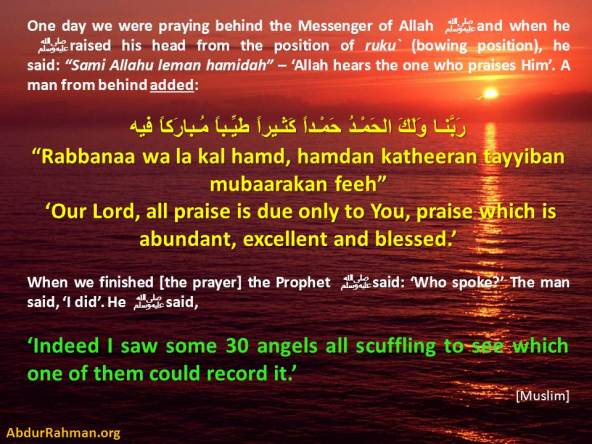
I'tidal اعتدال
Sesudah selesai melakukan rukuk diteruskan dengan I`tidal iaitu bangkit berdiri tegak dengan mengangkat kedua tangan sampai ke telinga dengan jari-jari terbuka seperti ketika TAKBIRATULIHRAM seraya membaca TASMI’.
(After completion of the bow do I`tidal namely stood upright with both hands lifted to the ear with the fingers open just like when TAKBIRATULIHRAM while reading TASMI.)
Ketika berdiri tegak, mata tetap ditujukan ke arah sujud .(tempat sujud)
(When standing upright, the eyes must still be directed towards the prostrate. (Place of prostration))
Thursday, May 12, 2011
Benefits of Prayers by Ibn Qayyim Jawzyah
In his excellent book, Zaad al-Ma'aad, in the section which includes the book, At-Tibb an-Nabawee, Shaykh al-Islaam Ibn al-Qayyim (may Allaah have Mercy on him) stated in his alphabetized discussion of medicines and nutrition:
Allaah the Exalted has said:
( And seek help in patience and in prayer. Surely that is something quite difficult on (people) other than people of humility and submissiveness )
And HE has said:
( O you who believe! Seek help in patience and in prayer! Verily, Allaah is with those who are patient. )
And HE, the Exalted One, has said:
(And command your family to pray, and be patient upon that. We are not asking you for any provisions,(rather) We provide for you, and the favorable outcome is for (those with) taqwaa (consciousness of Allaah that produces righteous actions). )
And in the Books of Sunnah it is reported that the Messenger of Allaah (sallallaahu 'alayhe wa sallam) used to hasten to prayer whenever an affair disturbed him.
And previously discussed was the concept of healing most ailments through prayer before seeking out other ways of dealing with them.
- 1 - Prayer is something that causes one to receive sustenance.
- 2 - It draws one close to Ar-Rahmaan (Allaah, the Most Merciful).
- 3 - It keeps away the Shaytaan (the Devil).
- 4 - It is something that safeguards one's physical health.
- 5 - It keeps away harmful things.
- 6 - It casts away illnesses.
- 7 - It strengthens the heart.
- 8 - It brightens one's countenance.
- 9 - It delights the soul.
- 10 - It gets rid of laziness.
- 11 - It makes the limbs active.
- 12 - It increases one's physical strength.
- 13 - It expands the chest (making one at ease and giving him insight).
- 14 - It is nourishment for the soul.
- 15 - It illuminates the heart.
- 16 - It safeguards one's blessings.
- 17 - It repels catastrophes.
- 18 - It brings on blessings.
And overall, it has an amazing effect on the health of the body and heart, and in strengthening them and expelling harmful pollutants from them. No two people have been afflicted with any disability, disease, or other calamity, except that the portion of the one who prays is less and his outcome is cleaner.
Also, prayer has an amazing effect on the evils of the dunyaa (the worldly life) and how it repels them, especially when the prayer is performed properly and completely, inwardly and outwardly. Nothing keeps the evils of the dunyaa at bay and brings on the benefits of it like prayer.
The reason behind this is that prayer is one's connection to Allaah, the Mighty and Majestic. So based on the strength of a person's relationship with his Lord, the Mighty and Majestic, the doors of goodness will accordingly be opened up for him, bad things and the reasons for them befalling him will be cut off, and the elements of success granted by His Lord, the Mighty and Majestic, will begin pouring in, along with safety and good health, wealth and worldly riches, relaxation, bliss, enjoyment, and all types of joyful affairs will be brought to him, and in an expedient manner, too.
( Here )
Wednesday, September 8, 2010
Eid Prayer

Short Description of the Eid Prayer and the Eid Khutbah
From Islamic Newsletter 'As-Sunnah' Issue no: 10
Compiled by Sister Shawana A. Aziz
From Islamic Newsletter 'As-Sunnah' Issue no: 10
Compiled by Sister Shawana A. Aziz
The Messenger of Allah (sallallahu alaihi wa-sallam) said: “Let the free women, the virgins, and the menstruating women attend the Eid prayer, and witness the good and the supplications of the believers. As for the menstruating women, they should stay away from the Musallah (i.e.. should not participate in the prayer itself).”
[Saheeh al-Bukharee and Saheeh Muslim]
[Saheeh al-Bukharee and Saheeh Muslim]
Eid ul Fitr Salah (Prayer) - Makkah - 1429 (2008)
صلاة العيد في الحرم المكي
صلاة العيد في الحرم المكي
1 - The Eid Salaah consists of two Raka'ahs. Umar (radhi allahu anhu) said: “The traveler’s prayer is two raka'ah; the Adha prayer is two Raka'ah; and the Jumuah prayer is two Rak'ah; this is their full length as came from the Messenger of Allah (sallallahu alaihi wa-sallam).”
[(saheeh) Musnad Ahmad, Nisa'ee, Baihaqee and others]
[(saheeh) Musnad Ahmad, Nisa'ee, Baihaqee and others]
2 - The Eid Salaah is not preceded by the adhan (the call to announce the prayer time) or Iqamah (the call to start prayer). Jabir bin Samurah (radhi allahu anhu) said: “I prayed the Eid prayer with Allah's Messenger (sallallahu alaihi wa-sallam), on more than one occasion, without adhan or Iqamah.”
[Saheeh Muslim]
[Saheeh Muslim]
3 - No Sunnah prayer may precede or follow the Eid prayer, except if it is performed in a Masjid instead of a Musallah, in which case one must pray two raka'hs before sitting down. Ibn Abbas (radhi allahu anhu) reported: “The Prophet (sallallahu alaihi wa-sallam) went out (of his house) on the day of Fitr, prayed two raka'hs and did not pray before or after it.”
[Zaad al-Maad (2/443)]
[Zaad al-Maad (2/443)]
4 - Like any other deed in Islam, the prayer must be preceded with a true intention of worshiping Allah alone in the heart.
5 - The first raka'h (one prayer unit) is initiated with Takbeer al-ihram, followed by the opening supplication.
6 - Then followed by seven Takbeers in the first raka'h and five more in the second rak'ah. Aa'ishah (radhi allahu anha) said: “Allah's Messenger (sallallahu alaihi wa-sallam) would say Takbeer in both Fitr and Adha: seven in the first and five in the second, other than the two Takbeers of Ruku (bowing).”
[(Saheeh) - Abu Dawood (1150) and others]
[(Saheeh) - Abu Dawood (1150) and others]
7 - After the Takbeer one should recite Ta'awwuth - 'A'uthu billahi min ash-Shaytaan ir-Rajeem' meaning “I seek refuge in Allah from the outcast devil” and Basmallah 'Bismillah ar-Rahmaan ar-Raheem' meaning 'In the Name of Allah, the Most Beneficent, the Most Merciful.'
8 - Followed by the recitation of Soorah al-Fatihah
9 - Then, the recitation of Soorah al-Qaaf in the first raka'h and the Soorah al-Qamar in the second - OR - Soorah al-Alaa in the first and Soorah al-Ghashiyah in the second.
Ibn al-Qayyim (rahimahullah) said: “Both of these have been authentically reported from the action of the Prophet (sallallahu alaihi wa-sallam), nothing else is authentic.”
[Zaad al-Maad (1/443)]
(Note: Reciting a Soorah different from the ones mentioned above will too complete the prayer.)
The remainder of the prayer is performed in the same manner as any other prayer, without any difference.
Ibn al-Qayyim (rahimahullah) said: “Both of these have been authentically reported from the action of the Prophet (sallallahu alaihi wa-sallam), nothing else is authentic.”
[Zaad al-Maad (1/443)]
(Note: Reciting a Soorah different from the ones mentioned above will too complete the prayer.)
The remainder of the prayer is performed in the same manner as any other prayer, without any difference.
Eid-ul-Fitr Salah - Madinah - 1429
The Eid Khutbah:
The Sunnah of the Eid Khutbah is that it should be delivered after the Eid Salaah. Ibn Abbas (radhi allahu anhu) said: “I attended the Eid with Allah's Messenger (sallallahu alaihi wa-sallam), Abu Bakr (radhi allahu anhu) Umar (radhi allahu anhu) and Uthman (radhi allahu anahu); all of them would pray before the Khutbah.”
[Saheeh al-Bukharee]
[Saheeh al-Bukharee]
Listening to the Eid Khutbah is not wajib , Abdullah bin as-Sa'ib (radhi allahu anhu) reported that he attended the Eid prayer with the Prophet (sallallahu alaihi wa-sallam); and when he (sallallahu alaihi wa-sallam) finished the prayer, he said: “We shall have a Khutbah; so let whoever wishes to sit for the Khutbah do so, and whoever wishes to leave, may leave.”
[(saheeh) Abu Dawood)]
[(saheeh) Abu Dawood)]
If the Eid falls on a Friday, it becomes optional for men to attend the Jumu'ah prayer. Abu Hurayrah (radhi allahu anhu) reported that on such occurrence, the Messenger of Allah (sallallahu alaihi wa-sallam) said: “Two Eids have coincided on this day of yours; thus whoever wishes, is exempted from attending the Jumu'ah prayer. Yet, we shall hold it.”
[Authenticated by Shaikh al-Albanee in Irwa ul-Ghalil]
[Authenticated by Shaikh al-Albanee in Irwa ul-Ghalil]
It should be noted that if one does not attend the Jumu’ah prayer, then it becomes obligatory on him to offer the Dhuhr prayer.
Sunday, August 15, 2010
How to pray from the Sunnah
*************************
How to pray from the Sunnah (1 of 5)
How to pray from the Sunnah (1 of 5)
*************************
How to pray from the Sunnah (2 of 5)
How to pray from the Sunnah (2 of 5)
*************************
How to pray from the Sunnah (3 of 5)
How to pray from the Sunnah (3 of 5)
*************************
How to pray from the Sunnah (4 of 5)
How to pray from the Sunnah (4 of 5)
*************************
How to pray from the Sunnah (5 of 5)
*************************
Tuesday, August 10, 2010
Ramadan Kareem - Taraweeh
****************************

The virtues of the Taraweeh Prayer
~ Abu Hurayrah said: Allah's Messenger (peace be upon him) said "He who prays during the night in Ramadan with faith and seeking his reward from Allah will have his past sins forgiven" (Agreed Upon)
~ The time for Taraweeh prayer is between Isha and Fajr. Generally during Ramadan the taraweeh prayer is prayed after the Isha prayer in the Masjids in congregation.
~ ‘Aa’ishah (may Allah be pleased with her) said: The Prophet (peace and blessings of Allah be upon him) used to pray eleven rak’ahs at night, and say the tasleem after each two rak’ahs, and he would pray Witr with one rak’ah. Saheeh, (agreed upon)
~ There is no set limit as to how much Quran is recited in each night of the taraweeh prayers.
The Prophet peace be upon him recitation used to vary, sometimes it would be long, at other times short. Sometimes in every rakah he would recite the equivalent of ‘Yaa ayyuha’l-muzammil, which is twenty aayaat; sometimes he would recite the equivalent of fifty aayaat.
He used to say, “Whoever prays at night and reads one hundred aayaat will not be recorded as one of the negligent.”
According to another hadeeth: “…and reads two hundred aayaat, will be recorded as one of the devout and sincere believers.”
He used to say, “Whoever prays at night and reads one hundred aayaat will not be recorded as one of the negligent.”
According to another hadeeth: “…and reads two hundred aayaat, will be recorded as one of the devout and sincere believers.”
Each day after the 8 rak'ahs of the Taraweeh prayers the witr are also prayed.
Du’aa’ which the Prophet (peace and blessings of Allah be upon him) taught to his grandson al-Hasan ibn ‘Ali (may Allah be pleased with him), which is (translation):
(O Allaah, guide me along with those whom You have guided, pardon me along with those whom You have pardoned, be an ally to me along with those whom You are an ally to, and bless for me that which You have bestowed.
Protect me from the evil You have decreed for verily You decree and none can decree over You. For surety, he whom You show allegiance to is never abased and he whom You take an enemy is never honored and mighty.
O our Lord, Blessed and Exalted are You. There is no refuge from You except with You).”
Protect me from the evil You have decreed for verily You decree and none can decree over You. For surety, he whom You show allegiance to is never abased and he whom You take an enemy is never honored and mighty.
O our Lord, Blessed and Exalted are You. There is no refuge from You except with You).”
Live broadcast of taraweeh (here)
"When My servants ask about Me, I am indeed close to them. I listen to the prayer of every supplicant, when he calls on Me. Let them also, with a will, listen to My call, and believe in Me, so that they may walk in the right way" (Qur'an 2:186).
Prayers and Du'a videos (here)
*******************
Tuesday, July 27, 2010
Monday, March 22, 2010
The fajr (dawn) prayer

The fajr (dawn) prayer is amongst the most important acts of worship, being one of the five obligatory prayers.
Unfortunately many have become so used to missing it at its prescribed time which ends at sunrise - have forgotten its position in the religion, and barely feel anything is wrong when waking up in the morning for work or school without having performed the fajr prayer.
Unfortunately many have become so used to missing it at its prescribed time which ends at sunrise - have forgotten its position in the religion, and barely feel anything is wrong when waking up in the morning for work or school without having performed the fajr prayer.
Muslims should know the great status of fajr in the sight of Allah. Allah (SWT) says (interpretation of the meaning) "Establish regular prayers at the sun's decline till the darkness of the night, and the recital of the Qurâan in the fajr prayer, for the recital of the fajr is witnessed". (Al-Israa 17:78)
In addition, the Prophet (PBUH) said: "Whoever prays the fajr prayer in congregation, it is as if he (or she) had prayed the whole night long".
[Muslim & Tirmidhi].
The Prophet (PBUH) "The most burdensome prayers for the hypocrites are ishaa and fajr, but if they only knew what they contain, they would come even if they had to crawl."
[Ahmad]

The practical aspect of dealing with the problem includes a number of steps which can be taken in order to get used to praying fajr regularly in congregation:
* Remembering Allaah upon waking up.
(http://www.islamicteachings.org/forum/five-pillars-of-islam/fajr-prayer-t1934.html)
Monday, December 14, 2009
Ruku'
Don’t rush through prayer
By Rahla Khan
(excerpt from : http://www.saudigazette.com.sa/index.cfm?method=home.regcon&contentID=2009121456980)
Obligation of Ruku’
The acts of bowing and prostrating in prayer are commanded in the Qur’an and made obligatory upon the believers:
“O you who believe! Bow down and prostrate yourselves and serve your Lord.” (Qur’an, 22:77)
Abu Mas’ud Al-Badri (may Allah be pleased with him) reported that the Prophet (peace be upon him) said, “The prayer of one who does not straighten his back in his bowing and prostration is not accomplished.”
[Narrated by “the five,’’ [narrators] and Ibn Khuzaimah, Ibn Hibban, at-Tabarani and al-Baihaqi]

Prophet’s manner of performing Ruku’.
In The Prophet’s Prayer Described, the Prophet’s manner of performing Ruku’ is narrated thus:
* “He would place his palms on his knees”, and “would order them (his Companions) to do likewise.”
* “He would put his hands firmly on his knees (as though he were grasping them).”
* “He would space his fingers out”, ordering “the one who prayed badly” likewise, saying: “When you make Ruku’, place your palms on your knees, then space your fingers out, then remain (like that) until every limb takes its (proper) place.”
* “He used to spread himself (i.e., not be in a compact position), and keep his elbows away from his sides.”
* “When he made Ruku’, he would spread his back and make it level, such that if water were poured on it, it (the water) would stay there (i.e., not run off).”
* He also said to “the one who prayed badly”, “When you make Ruku’, put your palms on your knees, spread your back (flat) and hold firm in your Ruku’.”
* “He would neither let his head droop nor raise it (i.e. higher than his back)”, but it would be in between.
* “He used to make his Ruku’, his standing after Ruku’, his Sujood (prostration), and his sitting in between the two Sajdas (prostrations), nearly equal in length.”
 (Muslims Offering Prayer in New York ~ www.islamicfinder.org/.../Salaat_in_New_Yo.jpg)
Inner dimensions of Ruku’.
In Ihya Ulum Ad-Din, in the Book of Prayer, Abu Hamid Al-Ghazali (may Allah have mercy upon him) writes, “Ruku’ and Sujud (prostration) are accompanied by a renewed affirmation of the supreme greatness of Allah.
In bowing you renew your submissiveness and humility, striving to refine your inner feeling through a fresh awareness of your own impotence and insignificance before the might and grandeur of your Lord. To confirm this, you seek the aid of your tongue, glorifying your Lord and testifying repeatedly to His supreme majesty, both inwardly and outwardly.”
While researchers today are slowly making the connection between prayer and physical and spiritual health, Ibn Al-Qayyim (may Allah have mercy upon him) wrote about it centuries ago in Za’ad Al-Ma’ad:
“Prayer has an amazing effect on the health of the body and heart, and in strengthening them and expelling harmful toxins from them. No two people have been afflicted with any disability, disease, or other calamity, except that the portion of the one who prays, is less (harmful) and his outcome is better.
Prayer also has an astounding effect on the evils of the Dunya (worldly life), especially when the prayer is performed properly and perfectly, inwardly and outwardly. Nothing keeps the evils of the Dunya at bay and brings on the benefits of it like prayer.
The reason behind this is that prayer is one’s connection to Allah, the Mighty and Majestic. So based on the strength of a person’s relationship with his Lord, the doors of goodness will accordingly be opened up for him, bad things and the reasons for them befalling him will be cut off, and the elements of success granted by His Lord, will begin pouring in…”
By Rahla Khan
(excerpt from : http://www.saudigazette.com.sa/index.cfm?method=home.regcon&contentID=2009121456980)
Obligation of Ruku’
The acts of bowing and prostrating in prayer are commanded in the Qur’an and made obligatory upon the believers:
“O you who believe! Bow down and prostrate yourselves and serve your Lord.” (Qur’an, 22:77)
Abu Mas’ud Al-Badri (may Allah be pleased with him) reported that the Prophet (peace be upon him) said, “The prayer of one who does not straighten his back in his bowing and prostration is not accomplished.”
[Narrated by “the five,’’ [narrators] and Ibn Khuzaimah, Ibn Hibban, at-Tabarani and al-Baihaqi]

Prophet’s manner of performing Ruku’.
In The Prophet’s Prayer Described, the Prophet’s manner of performing Ruku’ is narrated thus:
* “He would place his palms on his knees”, and “would order them (his Companions) to do likewise.”
* “He would put his hands firmly on his knees (as though he were grasping them).”
* “He would space his fingers out”, ordering “the one who prayed badly” likewise, saying: “When you make Ruku’, place your palms on your knees, then space your fingers out, then remain (like that) until every limb takes its (proper) place.”
* “He used to spread himself (i.e., not be in a compact position), and keep his elbows away from his sides.”
* “When he made Ruku’, he would spread his back and make it level, such that if water were poured on it, it (the water) would stay there (i.e., not run off).”
* He also said to “the one who prayed badly”, “When you make Ruku’, put your palms on your knees, spread your back (flat) and hold firm in your Ruku’.”
* “He would neither let his head droop nor raise it (i.e. higher than his back)”, but it would be in between.
* “He used to make his Ruku’, his standing after Ruku’, his Sujood (prostration), and his sitting in between the two Sajdas (prostrations), nearly equal in length.”
 (Muslims Offering Prayer in New York ~ www.islamicfinder.org/.../Salaat_in_New_Yo.jpg)
 Inner dimensions of Ruku’.
In Ihya Ulum Ad-Din, in the Book of Prayer, Abu Hamid Al-Ghazali (may Allah have mercy upon him) writes, “Ruku’ and Sujud (prostration) are accompanied by a renewed affirmation of the supreme greatness of Allah.
In bowing you renew your submissiveness and humility, striving to refine your inner feeling through a fresh awareness of your own impotence and insignificance before the might and grandeur of your Lord. To confirm this, you seek the aid of your tongue, glorifying your Lord and testifying repeatedly to His supreme majesty, both inwardly and outwardly.”
While researchers today are slowly making the connection between prayer and physical and spiritual health, Ibn Al-Qayyim (may Allah have mercy upon him) wrote about it centuries ago in Za’ad Al-Ma’ad:
“Prayer has an amazing effect on the health of the body and heart, and in strengthening them and expelling harmful toxins from them. No two people have been afflicted with any disability, disease, or other calamity, except that the portion of the one who prays, is less (harmful) and his outcome is better.
Prayer also has an astounding effect on the evils of the Dunya (worldly life), especially when the prayer is performed properly and perfectly, inwardly and outwardly. Nothing keeps the evils of the Dunya at bay and brings on the benefits of it like prayer.
The reason behind this is that prayer is one’s connection to Allah, the Mighty and Majestic. So based on the strength of a person’s relationship with his Lord, the doors of goodness will accordingly be opened up for him, bad things and the reasons for them befalling him will be cut off, and the elements of success granted by His Lord, will begin pouring in…”
Thursday, November 26, 2009
Q & A : Praying in the Sacred Mosque

Rahma - Poland
Question : Passing in Front of a Praying Person in the Sacred Mosque
Date - 01/Jun/2005
Dear scholars, as-salamu `alaykum. Is it permissible to offer prayer in the Sacred Mosque in Makkah while people pass in front of the those who are praying? Jazakum Allah khayran.
Answer :
Wa `alaykum As-Salamu wa Rahmatullahi wa Barakatuh.
In the Name of Allah, Most Gracious, Most Merciful.
All praise and thanks are due to Allah, and peace and blessings be upon His Messenger.
Dear questioner, we would like to thank you for the great confidence you place in us, and we implore Allah, the Almighty to help us serve His cause and render our work for His Sake alone.
It is permissible to offer prayer in the Sacred Mosque in Makkah while the people are passing in front of the praying person and this is one of the special characteristics of the Sacred Mosque.
In this regard, we will cite what Sheikh Sayyed Sabiq states in his well-known book, Fiqh As-Sunnah:
It is permissible to offer prayer in the Sacred Mosque in Makkah while the people, male or female, are passing in front of the worshipper. There is no harm in it, and it is one of the special characteristics of the Sacred Mosque.
Kathir Ibn Kathir Ibn Al-Muttalib bin Wida`ah reported from some of his relatives and from his grandfather that he said: "I saw the Prophet (peace and blessings be upon him) offering prayer in the Sacred Mosque in the area adjacent to Bani Sahm while people were passing in front of him but he did not place any sutrah (something that a praying person puts in front of him in order to alert people that they should not pass in front of him while praying) in front of him.”
Sufyan Ibn `Uyainah said, "There was no sutrah between him and the Ka`bah." (Abu Dawud, An-Nasa’i, and Ibn Majah)
Wednesday, November 11, 2009
Solat : "Dedicated to beginners"
For clearer view, please refer :
(http://www.howdoipray.com/howdoipray/Home/)
Tuesday, November 3, 2009
Solat Tasbeeh
It is recorded in Sunan Abi Dawud and other books of hadith that Rasulullah (sallallahu `alayhi wasallam) once said to his uncle Hadrat `Abbas (r.a.) :
"O Abbas!O my uncle! Shall I not give you a gift? Shall I not show you something by means of which Allah Ta`ala will forgive your sins, the first and the last of them, the past and recent, the unintentional and the intentional, the small and huge, the secret and open?"
Rasulullah (sallallahu `alayhi wasallam) then taught him the Solat Tasbeeh.
Furthermore he advised him that it be offered daily, if possible. If not then every Friday or once a month or once a year or at least once in one's life time.
Solat Tasbeehh consists of 4 raka`ahs. It can be performed any time of the day or night except at the makruh times.
The following tasbeeh is recited seventy-five times in each raka`ah totalling 300 in the 4 raka`ah.
Furthermore he advised him that it be offered daily, if possible. If not then every Friday or once a month or once a year or at least once in one's life time.
Solat Tasbeehh consists of 4 raka`ahs. It can be performed any time of the day or night except at the makruh times.
The following tasbeeh is recited seventy-five times in each raka`ah totalling 300 in the 4 raka`ah.

(Subhaanallaahi walhamdu lillaahi walaa ilaaha illallaahu wallaahu akbar)
The method of this solat is as follows:
* After beginning the solat by saying Allah-u-Akbar recite the thana ', Sura al-Fatiha and a Sura followed by the above tasbeeh 15 times.
* Then go into Ruku and after reciting the usual tasbeeh for ruku` recite the above tasbeeh 10 times.
* After standing up from ruku` recite the usual Rabbana Lakal Hamd and thereafter recite the tasbeeh 10 times.
* Then go into Sajda and after reciting the usual tasbeeh for sajda recite the above tasbeeh 10 times.
* Then sit up from sajda and recite the tasbeeh 10 times between the two sajdas.
* Thereafter go into sajda again and after reciting the usual tasbeeh for sajda recite the above tasbeeh 10 times.
* Then sit after the 2nd sajda (i.e. before standing up for the second raka`ah) and recite the tasbeeh 10 times.
This adds up to 75 times in one raka`ah.
Do the same for the remaining 4 raka`ah.
[Note : If at night, this solat can be performed with 2 salams - 2 raka'ahs each]
Do the same for the remaining 4 raka`ah.
[Note : If at night, this solat can be performed with 2 salams - 2 raka'ahs each]
(http://sunnipath.com/)
Thursday, October 15, 2009
Tahajjud
Al-Muzzammil (Surah 73)
In the name of Allah, the Beneficent, the Merciful
"O you wrapped in garments (i.e. Prophet Muhammad SAW)! (1) Stand (to pray) all night, except a little. (2) Half of it, or a little less than that, (3) Or a little more; And recite the Qur'ân (aloud) in a slow, (pleasant tone and) style[] (4) Verily, We shall send down to you a weighty Word (i.e. obligations, laws). (5) Verily, the rising by night (for Tahajjud prayer) is very hard and most potent and good for governing oneself, and most suitable for (understanding) the Word (of Allâh). "(6)
The following acts are recommended for one who wishes to perform the Tahajjud Prayer:
* Upon going to sleep, one should make the intention to perform the Prayers. Abu Ad-Darda' quoted the Prophet (peace and blessings be upon him) as saying:
“Whoever goes to his bed with the intention of getting up and praying during the night, but, being overcome by sleep, fails to do that, he will have recorded for him what he has intended, and his sleep will be reckoned as a charity (an act of mercy) for him from his Lord.” (An-Nasa'i and Ibn Majah)
* On waking up, it is recommended that one wipes the face, use a toothbrush, and look to the sky and make the supplication which has been reported from the Prophet (peace and blessings be upon him).
Abu Hudhaifa reported:
"Whenever the Prophet intended to go to bed, he would recite: (With Your name, O Allah, I die and I live)." And when he woke up from his sleep, he would say: (All the Praises are for Allah Who has made us alive after He made us die (sleep) and unto Him is the Resurrection.)" (Al-Bukhari)
* One should begin with two quick rak`ahs and then one may pray whatever one wishes after that. `A’ishah said:
“When the Prophet prayed during the late-night, he would begin his Prayers with two quick rak`ahs.” (Muslim)
* It is recommended that one wakes up one's family, for Abu Hurairah quoted the Prophet (peace and blessings be upon him) as saying:
“May Allah bless the man who gets up during the night to pray and wakes up his wife and who, if she refuses to get up, sprinkles water on her face. And may Allah bless the woman who gets up during the night to pray and wakes up her husband and who, if he refuses, sprinkles water on his face.” (Ahmad)
The Prophet (peace and blessings be upon him) also said:
“If a man wakes his wife and prays during the night or they pray two rak`ahs together, they will be recorded among those (men and women) who (constantly) make remembrance of Allah.” (Abu Dawud.)
* If one gets sleepy while performing Tahajjud, one should sleep. This is based on the hadith narrated by `A’ishah (may Allah be pleased with her), who quoted Allah’s Messenger as saying:
“When one of you gets up during the night for Prayer and his Qur’anic recital gets mixed up to the extent that he does not know what he says, he should lie down.” (Muslim.)
Tahajjud may be performed in the early part of the night, the middle part of the night, or the latter part of the night, but after the obligatory `Isha’ Prayer (night Prayer).
It is best to delay this Prayer to the last third portion of the night. Abu Hurairah (may Allah be pleased with him) quoted the Messenger of Allah (peace and blessings be upon him) as saying:
“Our Lord descends to the lowest heaven during the last third of the night, inquiring: ‘Who will call on Me so that I may respond to him? Who is asking something of Me so I may give it to him? Who is asking for My forgiveness so I may forgive him?’” (Al-Bukhari)
`Amr ibn `Absah (may Allah be pleased with him) reported that he heard the Prophet (peace and blessings be upon him) saying:
“The closest that a slave comes to his Lord is during the middle of the latter portion of the night. If you can be among those who remember Allah the Exalted One at that time, then do so.” (At-Tirmidhi)
Tahajjud Prayer does not entail a specific number of rak`ahs that must be performed, nor is there any maximum limit that may be performed. It would be fulfilled even if one prayed just one rak`ah of Witr after `Isha’.
Samurah ibn Jundub (may Allah be pleased with him) said:
“The Messenger of Allah ordered us to pray during the night, a little or a lot, and to make the last of the Prayer the Witr Prayer.” (At-Tabarani and Al-Bazzar)
In Du’a : The Weapon of the Believer by Shaykh Yasir Qadhi (Chapter 7)
1) Allah describes the true believers as those who:
‘…and, in the hours of dawn, they seek forgiveness from their Lord…’ Surah Al-Dhariyat, Ayah 18
The distinction between a believer and one who is just a Muslim is further defined by this act.
2) The doors of Mercy and Forgiveness are open during the last 1/3 of night:
Abu Hurayrah narrated that the Prophet (peace and blessings of Allaah be upon him) said:
Our Lord descends every night, during the last third of it, to the skies of this world, and asks: ‘Who is making du’aa to me, so that I can respond to him? Who is asking Me, so that I can give him? Who is asking for My forgiveness, so that I can forgive him?’
(Reported by al-Bukhari and Muslim from Abu Hurayrah)
3) If a person wishes his/her Du’aa to be accepted this is the best time to ask as shown in hadeeth above.
4) Huge incentive for the believer to wake up when everyone else is asleep and remember Allah (Subbhana Wa Ta’ala) privately.
5) Allah favored this time over other times and Allah distinguised this timing so that the worshipper can eagerly anticipate this time and pray earnestly and sincerely; The worshipper should ensure his/her du’aa is more frequent and sincere during these times.
DUA TO ASSIST ONE IN AWAKENING FOR TAHAJJUD
A person remarked to Abdullah bin Abbas [radhiyallahu anhu], "I always intend awakening in the last portion of the night to perform Salaat but sleep overpowers me."
Ibn Abbas [radhiyallahu anhu] replied, "Before sleeping recite from "QUL LAW KAANAL BAHRU MIDADAL..." to the end of Surah Kahf. Allah Ta'ala will waken you at whatever time you intend rising." [Tha'labi-Ma'ariful Quraan vol 5]
قُل لَّوۡ كَانَ ٱلۡبَحۡرُ مِدَادً۬ا لِّكَلِمَـٰتِ رَبِّى لَنَفِدَ ٱلۡبَحۡرُ قَبۡلَ أَن تَنفَدَ كَلِمَـٰتُ رَبِّى وَلَوۡ جِئۡنَا بِمِثۡلِهِۦ مَدَدً۬ا (١٠٩
"Say (O Muhammad SAW to mankind). "If the sea were ink for (writing) the Words of my Lord, surely, the sea would be exhausted before the Words of my Lord would be finished, even if we brought (another sea) like it for its aid." (109)
قُلۡ إِنَّمَآ أَنَا۟ بَشَرٌ۬ مِّثۡلُكُمۡ يُوحَىٰٓ إِلَىَّ أَنَّمَآ إِلَـٰهُكُمۡ إِلَـٰهٌ۬ وَٲحِدٌ۬ۖ فَمَن كَانَ يَرۡجُواْ لِقَآءَ رَبِّهِۦ فَلۡيَعۡمَلۡ عَمَلاً۬ صَـٰلِحً۬ا وَلَا يُشۡرِكۡ بِعِبَادَةِ رَبِّهِۦۤ أَحَدَۢا (١١٠)
"Say (O Muhammad SAW): "I am only a man like you. It has been revealed to me that your Ilâh (God) is One Ilâh (God — i.e. Allâh). So whoever hopes for the Meeting[] with his Lord, let him work righteousness and associate none as a partner in the worship of his Lord." (110)
*******
Narrated Aisha r.a:
Once in the middle of the night Allah's Apostle (p.b.u.h) went out and prayed in the mosque and some men prayed with him. The next morning the people spoke about it and so more people gathered and prayed with him (in the second night). They circulated the news in the morning, and so, on the third night the number of people increased greatly. Allah's Apostle (p.b.u.h) came out and they prayed behind him.
On the fourth night the mosque was overwhelmed by the people till it could not accommodate them. Allah's Apostle came out only for the Fajr prayer and when he finished the prayer, he faced the people and recited "Tashah-hud" (I testify that none has the right to be worshipped but Allah and that Muhammad is His Apostle), and then said,
"Amma ba'du. Verily your presence (in the mosque at night) was not hidden from me, but I was afraid that this prayer (Prayer of Tahajjud) might be made compulsory and you might not be able to carry it out."
Sunday, August 16, 2009
VIRTUE OF DHUHA
The time of Dhuha begins when the sun is about a spear’s length above the horizon and
it continues until the sun reaches its meridian. It is preferred to delay it until the sun has risen high and the day has become hot.
The minimum number of rak’ahs to be prayed is two. The most that the Prophet
(SAW) performed was eight rak’ahs. Umm Hani narrated that the Prophet (SAW)
prayed eight rak’ahs of Dhuha and made the taslim after every two rak’ahs.
(Abu Dawud)
After the completion of the prayer, one is recommended to recite the following du’a:
it continues until the sun reaches its meridian. It is preferred to delay it until the sun has risen high and the day has become hot.
The minimum number of rak’ahs to be prayed is two. The most that the Prophet
(SAW) performed was eight rak’ahs. Umm Hani narrated that the Prophet (SAW)
prayed eight rak’ahs of Dhuha and made the taslim after every two rak’ahs.
(Abu Dawud)
After the completion of the prayer, one is recommended to recite the following du’a:

DHUHA (Chaasht) SALAAH:
According to authentic Ahaadeeth of Rasulullah [sallallaahu alayhi wasallam]:
When anyone of you awakens in the morning, you must give sadaqah (charity) for every joint (of your body).
So, every tasbih is sadaqah and every tahmeed is sadaqah and and every tahleel is sadaqah and every takbeer is sadaqah and to enjoin a good action is sadaqah and forbidding an evil action is sadaqah.
And equal to all of this collectively is (the reward) a person gains from performing two raka’aat at the time of Dhuhaa (Chaasht).
(Sahih Muslim)
According to authentic Ahaadeeth of Rasulullah [sallallaahu alayhi wasallam]:
When anyone of you awakens in the morning, you must give sadaqah (charity) for every joint (of your body).
So, every tasbih is sadaqah and every tahmeed is sadaqah and and every tahleel is sadaqah and every takbeer is sadaqah and to enjoin a good action is sadaqah and forbidding an evil action is sadaqah.
And equal to all of this collectively is (the reward) a person gains from performing two raka’aat at the time of Dhuhaa (Chaasht).
(Sahih Muslim)
**************************
(http://www.islaam.com/Article.aspx?id=518)
From Anas bin Malik, may Allah be pleased with him, who said: "The Messenger of Allah, sallallahu `alayhi wa sallam, said:
'Whoever prays the morning prayer in congregation then sits remembering Allah until the sun rises, then prays two units of prayer has the reward like that of Hajj and `Umrah.'" He said, "Allah's Messenger, sallallahu `alayhi wa sallam, said: 'Complete, complete, complete (i.e. reward).'"
(Related by at-Tirmidhi (2/586), Takhreej Ahmad Shakir. `Abu `Isa (at-Tirmidhi) said: This hadeeth is hasan ghareeb. Shakir said in his verification: At-Tirmidhi declared it hasan, and in its chain of narrators is Abu Dhilaal, and he has been spoken about, but the hadeeth has other supporting narrations. Al-Albani declared it hasan in Saheeh at-Tirmidhi (591) and At-Ta`leeq ar-Ragheeb (164 and 165) and Saheeh at-Targheeb (1/461) and declared it saheeh in Saheeh al-Jaami` (6346).)
---------------------------
From Abi Umaamah who said: "Allah's Messenger, sallallahu `alayhi wa sallam, said:
'Whoever prays the morning prayer in congregation then sits remembering Allah until he sun rises, then stands up ad prays two units of prayer returns with the reward of Hajj and `Umrah.'"
[Majma` uz-Zawaid of al-Haythami 10/104-105] Related by at-Tabarani and its isnad is good. Al-Albani declared it hasan in Saheeh at-Targheeb (1/464)]
--------------------------
From `Usrah who said, "I heard the Mother of believers, meaning `Aa'isha, say:
'I heard Allah's Messenger, sallallahu `alayhi wa sallam, say: 'Whoever prays fajr (or he said al-ghadaah, [transl. both referring to the morning prayer]), then sits in his place and does not speak idly with something from matters of this world and remembers Allah until he prays four units of Dhuha, he will leave his sins like the day his mother bore him, without any sin.''"
[al-Mataalib al-`Aaliyah bi Zawaa'id al-Masaaneed ath-Thamaaniyah of Ibn Hajr (3/3394), takhreej: Habeeb ur-Rahman al-A`dhami. The authenticator said: "Al-Buwaysari said: 'Abu Ya`laa related it about Salat adh-Dhuha with a hasan chain.'"] Related by Abu Ya`laa and at-Tabarani related something similar to it in al-Awsat.
(http://www.islaam.com/Article.aspx?id=518)
From Anas bin Malik, may Allah be pleased with him, who said: "The Messenger of Allah, sallallahu `alayhi wa sallam, said:
'Whoever prays the morning prayer in congregation then sits remembering Allah until the sun rises, then prays two units of prayer has the reward like that of Hajj and `Umrah.'" He said, "Allah's Messenger, sallallahu `alayhi wa sallam, said: 'Complete, complete, complete (i.e. reward).'"
(Related by at-Tirmidhi (2/586), Takhreej Ahmad Shakir. `Abu `Isa (at-Tirmidhi) said: This hadeeth is hasan ghareeb. Shakir said in his verification: At-Tirmidhi declared it hasan, and in its chain of narrators is Abu Dhilaal, and he has been spoken about, but the hadeeth has other supporting narrations. Al-Albani declared it hasan in Saheeh at-Tirmidhi (591) and At-Ta`leeq ar-Ragheeb (164 and 165) and Saheeh at-Targheeb (1/461) and declared it saheeh in Saheeh al-Jaami` (6346).)
---------------------------
From Abi Umaamah who said: "Allah's Messenger, sallallahu `alayhi wa sallam, said:
'Whoever prays the morning prayer in congregation then sits remembering Allah until he sun rises, then stands up ad prays two units of prayer returns with the reward of Hajj and `Umrah.'"
[Majma` uz-Zawaid of al-Haythami 10/104-105] Related by at-Tabarani and its isnad is good. Al-Albani declared it hasan in Saheeh at-Targheeb (1/464)]
--------------------------
From `Usrah who said, "I heard the Mother of believers, meaning `Aa'isha, say:
'I heard Allah's Messenger, sallallahu `alayhi wa sallam, say: 'Whoever prays fajr (or he said al-ghadaah, [transl. both referring to the morning prayer]), then sits in his place and does not speak idly with something from matters of this world and remembers Allah until he prays four units of Dhuha, he will leave his sins like the day his mother bore him, without any sin.''"
[al-Mataalib al-`Aaliyah bi Zawaa'id al-Masaaneed ath-Thamaaniyah of Ibn Hajr (3/3394), takhreej: Habeeb ur-Rahman al-A`dhami. The authenticator said: "Al-Buwaysari said: 'Abu Ya`laa related it about Salat adh-Dhuha with a hasan chain.'"] Related by Abu Ya`laa and at-Tabarani related something similar to it in al-Awsat.
Friday, August 7, 2009
Salaat-ul-Istikhara
Bismillahi Rahmani Raheem
Assalaamu alaikum wa Rahmatullahi wa Barakatuhu
Salaat-ul-Istikhara and its Rulings
(Summary from the Book, "The Three Abandoned Prayers" by Shaykh Adnaan Ali Uroor)
When the servant is concerned about an affair or decides upon a matter, or a problem arises in his mind and he wishes to act upon it, then he should seek guidance from his Lord before embarking upon it (as established in Sahih Bukhari vol.2, no.263; Ahmad 3/344; Abu Dawood vol.1. no.1533, an-Nasa'i no.3253, Tirmidhi no.480, Ibn Majah no.1383) by the following:
FIRSTLY: that he fulfills all the conditions of superogatory prayer - which are the same conditions for the obligatory prayer except the condition of enterning of the time for that particular prayer.
SECONDLY: that he prays two rakaahs of superogatory prayer, with the intention of al-Istikharaah (seeking guidance).
THIRDLY: after the prayer, he should make the supplication of al-Istikharaah:
Translation:
"O Allah, I seek your counsel by Your knowledge and I seek your assistance by Your power and I ask You from Your immense favor, for verily You are able while I am not, and verily You know while I do not, and You are the Knower of the Unseen. O Allah, if You know this affair (and here he mentions his need) to be good for me in relation to my religion, my life and aftermath, then decree it and facilitate it for me, and bless me with it, and if You know this affair to be ill for me concerning my religion, my life and end, then remove me from it, and decree for me what is good, wherever it maybe, and make me satisfied with it"
"The du'aa of one of you in answered so long as he does not become impatient and say "I made a du'aa to my Lord but He did not answer me"" (Bukhari, vol.8 352; Muslim, vol.4 6595).
FOURTHLY: He should have a strong assurance in his Lord and truthful reliance upon his Lord , being sure of guidance, waiting for the answer.
SOME FURTHER POINTS
* Salaat ul Istikharaah is not allowed in the times when salah is prohibited
*There is no specific surah to be recited in al-Istikharaah.
*The du'aa is to be performed after the two rakahs, without interruption. If one forgets to say it immediately but he still has wudhu and is still sitting then he should make it. If one has walked away then he must repeat the two rakahs.
* It is necessary to adhere to the exact text - "Verily the wordings of the duas are maintained exactly to the form established from the Prophet" (an-Nawawi, al-Majmoo 3/495). The scholars differ whether one is permitted to say something before the dua (praising Allah swt) and after it (saying salaam on the Prophet saw), as the general evidences for du'aa suggest this; or if it should be disallowed given al-istikharaah is a specific du'aa, therefore it is not befitting to add to it.
*The general rule is one hands should be raised unless proved that the Prophet (saw) did not do this in a particular dua. "Verily your Lord is generous, shy. If His servant raises his hands to Him (in supplication) He becomes shy to return them empty" (Ahmad, Abu Dawood vol.1 1483, Tirmidhi)
* Whether ones heart inclines towards something before al-Istikharah or not, the individual should still make al-Istikharaah for this affair.
*The individual should also seek guidance from those whom he knows to be righteous, whether before or after performing al-Istikharaah.
*****************************
"There is not a Muslim on the face of the earth that invokes Allah with a supplication except that he will be granted it or will be protected from an evil equal to his supplication, so long as the supplication is not for a sinful matter or for severing the family ties"
(Tirmidhi no.3568; see also Ahmad 3/18; and al-Haakim 1/493)
Assalaamu alaikum wa Rahmatullahi wa Barakatuhu
Salaat-ul-Istikhara and its Rulings
(Summary from the Book, "The Three Abandoned Prayers" by Shaykh Adnaan Ali Uroor)
(http://www.geocities.com/albayaan/shaban1421/istikhara.html)
When the servant is concerned about an affair or decides upon a matter, or a problem arises in his mind and he wishes to act upon it, then he should seek guidance from his Lord before embarking upon it (as established in Sahih Bukhari vol.2, no.263; Ahmad 3/344; Abu Dawood vol.1. no.1533, an-Nasa'i no.3253, Tirmidhi no.480, Ibn Majah no.1383) by the following:
FIRSTLY: that he fulfills all the conditions of superogatory prayer - which are the same conditions for the obligatory prayer except the condition of enterning of the time for that particular prayer.
SECONDLY: that he prays two rakaahs of superogatory prayer, with the intention of al-Istikharaah (seeking guidance).
THIRDLY: after the prayer, he should make the supplication of al-Istikharaah:
Translation:
"O Allah, I seek your counsel by Your knowledge and I seek your assistance by Your power and I ask You from Your immense favor, for verily You are able while I am not, and verily You know while I do not, and You are the Knower of the Unseen. O Allah, if You know this affair (and here he mentions his need) to be good for me in relation to my religion, my life and aftermath, then decree it and facilitate it for me, and bless me with it, and if You know this affair to be ill for me concerning my religion, my life and end, then remove me from it, and decree for me what is good, wherever it maybe, and make me satisfied with it"
"The du'aa of one of you in answered so long as he does not become impatient and say "I made a du'aa to my Lord but He did not answer me"" (Bukhari, vol.8 352; Muslim, vol.4 6595).
FOURTHLY: He should have a strong assurance in his Lord and truthful reliance upon his Lord , being sure of guidance, waiting for the answer.
SOME FURTHER POINTS
* Salaat ul Istikharaah is not allowed in the times when salah is prohibited
*There is no specific surah to be recited in al-Istikharaah.
*The du'aa is to be performed after the two rakahs, without interruption. If one forgets to say it immediately but he still has wudhu and is still sitting then he should make it. If one has walked away then he must repeat the two rakahs.
* It is necessary to adhere to the exact text - "Verily the wordings of the duas are maintained exactly to the form established from the Prophet" (an-Nawawi, al-Majmoo 3/495). The scholars differ whether one is permitted to say something before the dua (praising Allah swt) and after it (saying salaam on the Prophet saw), as the general evidences for du'aa suggest this; or if it should be disallowed given al-istikharaah is a specific du'aa, therefore it is not befitting to add to it.
*The general rule is one hands should be raised unless proved that the Prophet (saw) did not do this in a particular dua. "Verily your Lord is generous, shy. If His servant raises his hands to Him (in supplication) He becomes shy to return them empty" (Ahmad, Abu Dawood vol.1 1483, Tirmidhi)
* Whether ones heart inclines towards something before al-Istikharah or not, the individual should still make al-Istikharaah for this affair.
*The individual should also seek guidance from those whom he knows to be righteous, whether before or after performing al-Istikharaah.
*****************************
"There is not a Muslim on the face of the earth that invokes Allah with a supplication except that he will be granted it or will be protected from an evil equal to his supplication, so long as the supplication is not for a sinful matter or for severing the family ties"
(Tirmidhi no.3568; see also Ahmad 3/18; and al-Haakim 1/493)
Wednesday, August 5, 2009
Salaah - Taraweeh Prayer

From : (http://ramadan.com.au/prayer?start=9)
‘Taraweeh prayers are daily night prayers observed after Isha prayer in Ramadan and can be carried out in congregation or individually. Although not compulsory but widely practiced, Taraweeh prayers are recognized as a special part of the holy month of Ramadan for Muslims.
The reason why Muslims prayer the Taraweeh prayer can be best explained in the following hadith.
“The Messenger of Allah, sala Allahu alahi wa sallam, said: "Whoever observes night prayer in Ramadan as an expression of his faith and to seek reward from Allah, his previous sins will be blotted out." (Muslim)
The practice of performing Taraweeh prayers in the mosque was established by our beloved Prophet Mohammed, sala Allahu alahi wa sallam. However, he did not continually observe the Taraweeh prayers in the mosque for fear that it would be made compulsory on all Muslims to do so throughout the Holy month of Ramadan.
Taraweeh prayers consist of various numbers of raka'ats, generally ranging from 8 to 20 (not including the witr prayer). Muslims are encouraged to perform the Taraweeh prayers in Ramadan to increase their level of spirituality amongst many other benefits.
Taraweeh is an opportunity to acquire the pleasure of Allah swt. Depending on a Muslims physical strength, time constraints and willingness, Taraweeh prayer can be varied in units and extended for greater rewards in the manner of more rakaa’s prayed or longer surat being read. In fact it is sunnah to complete reading the entire Quran in Taraweh prayer in Ramadan.
"The Messenger of Allah, (sala Allahu alahi wa sallam), observed Taraweeh prayer in the mosque one night and people prayed with him. He repeated so the following night and the number of participants grew. The companions congregated the third and fourth night, but the Messenger did not show up.
In the morning he told them, "I saw what you did last night, but nothing prevented me from joining you except my fear that it might be made mandatory on you in Ramadan."
It was only Omar bin kutab (r.a), that had made the companions join together and pray Taraweeh in congregation.
Apart from the obvious benefits as mentioned in the hadith above, Taraweeh prayer other positives include building a sense of community by bringing together Muslims during Ramadan every evening, physical benefits through mediation and movement of the body, and building and strengthening a spiritually conducive environment for Muslims.
It is in fact quite common that the leader of the congregation, the Imam, recites the entire Qur'an throughout the month. This gives the listeners a chance to hear the Holy Qur'an in its entirety and gives them a chance to reflect over its meanings. It is common to see grown men cry and shed tears as they reflect on the words of their creator, and they reflect on their lives.
Praying Taraweeh, with sincerity and correctly not only wipes away previous sins and increases the level of closeness to Allah swt, building greater conviction, and certainty, which strengthens a Muslim in their speech and actions in and outside of Ramadan.
For most Muslims as they approach the end of the month of Ramadan, the aura in the air at Taraweeh prayers is one of sadness and sorrow that this special prayer is gone for another year.
The Muslim who has the capacity, but fails to grasp the opportunity of performing the Taraweeh prayers with sincerity and correctly, knowing well the benefits of it, truly suffers from a poverty of incorrect priorities.
The reason why Muslims prayer the Taraweeh prayer can be best explained in the following hadith.
“The Messenger of Allah, sala Allahu alahi wa sallam, said: "Whoever observes night prayer in Ramadan as an expression of his faith and to seek reward from Allah, his previous sins will be blotted out." (Muslim)
The practice of performing Taraweeh prayers in the mosque was established by our beloved Prophet Mohammed, sala Allahu alahi wa sallam. However, he did not continually observe the Taraweeh prayers in the mosque for fear that it would be made compulsory on all Muslims to do so throughout the Holy month of Ramadan.
Taraweeh prayers consist of various numbers of raka'ats, generally ranging from 8 to 20 (not including the witr prayer). Muslims are encouraged to perform the Taraweeh prayers in Ramadan to increase their level of spirituality amongst many other benefits.
Taraweeh is an opportunity to acquire the pleasure of Allah swt. Depending on a Muslims physical strength, time constraints and willingness, Taraweeh prayer can be varied in units and extended for greater rewards in the manner of more rakaa’s prayed or longer surat being read. In fact it is sunnah to complete reading the entire Quran in Taraweh prayer in Ramadan.
"The Messenger of Allah, (sala Allahu alahi wa sallam), observed Taraweeh prayer in the mosque one night and people prayed with him. He repeated so the following night and the number of participants grew. The companions congregated the third and fourth night, but the Messenger did not show up.
In the morning he told them, "I saw what you did last night, but nothing prevented me from joining you except my fear that it might be made mandatory on you in Ramadan."
It was only Omar bin kutab (r.a), that had made the companions join together and pray Taraweeh in congregation.
Apart from the obvious benefits as mentioned in the hadith above, Taraweeh prayer other positives include building a sense of community by bringing together Muslims during Ramadan every evening, physical benefits through mediation and movement of the body, and building and strengthening a spiritually conducive environment for Muslims.
It is in fact quite common that the leader of the congregation, the Imam, recites the entire Qur'an throughout the month. This gives the listeners a chance to hear the Holy Qur'an in its entirety and gives them a chance to reflect over its meanings. It is common to see grown men cry and shed tears as they reflect on the words of their creator, and they reflect on their lives.
Praying Taraweeh, with sincerity and correctly not only wipes away previous sins and increases the level of closeness to Allah swt, building greater conviction, and certainty, which strengthens a Muslim in their speech and actions in and outside of Ramadan.
For most Muslims as they approach the end of the month of Ramadan, the aura in the air at Taraweeh prayers is one of sadness and sorrow that this special prayer is gone for another year.
The Muslim who has the capacity, but fails to grasp the opportunity of performing the Taraweeh prayers with sincerity and correctly, knowing well the benefits of it, truly suffers from a poverty of incorrect priorities.
Saturday, August 1, 2009
5 DAILY OBLIGATORY SOLAH
Allah states in Surah At Taubah verse 103 :
" Verily ! Your solahs are a source of security for them, and Allah is All- Hearer, All Knower."
Solah is defined as :
1. Mukallaf ( reached the age of pubescence ).
2. Sane
3. Free from menstruation ( haid ) and post child-birth ( nifas ).
These Solah are determined by its time period and cannot be performed before or after its pre-determined time.
These timings were taught by Angel Gabriel to Prophet Muhammad (peace be upon him) after the occasion of Israk and Mi'raj.
1. Fajar (2 Raka'ats)
The time of Fajar starts from the break of dawn ( fajar sadiq ) till the sunrise.
2. Zuhur (4 Raka'ats)
The time of Zuhur starts when the sun passes its median to the West. During this time, the shadow of each object starts elongating towards the East.The time for Zuhur continues till the length of the shadow is the same as the object itself.
3. 'Asar (4 Raka'ats)
The time of 'Asar starts when the shadow of each object equals its own height. It continues till sunset.
4. Maghrib (3 Raka'ats)
The time for Maghrib starts from sunset and continues till the redness of the clouds ( syafak ahmar ) dissappears.
5. 'Isyak (4 Raka'ats)
The time for 'Isyak starts when the redness of the clouds clears and continues till the break of dawn.
" Verily ! Your solahs are a source of security for them, and Allah is All- Hearer, All Knower."
Solah is defined as :
Specific words and actions that begins with "takbiratul ihram" and ends with the "salaam".
It is a gift to Muslims from Allah, a form of prayer that includes a number of Rakaah (praying during standing, bowing, prostrating and sitting) whilst facing the Qiblah (Direction towards the Ka'abah in Makkah, Arabia).
Salaah is performed in a specific manner, read in Arabic and includes recitations of the Holy Quran and words of that praise, gratify and glorify Allah - The Most Beneficent, The Most Merciful.
Five salaah are (Fardh) obligatory and are the second pillar of Islaam, and compulsory upon every Muslims that fulfils the following requirement :
It is a gift to Muslims from Allah, a form of prayer that includes a number of Rakaah (praying during standing, bowing, prostrating and sitting) whilst facing the Qiblah (Direction towards the Ka'abah in Makkah, Arabia).
Salaah is performed in a specific manner, read in Arabic and includes recitations of the Holy Quran and words of that praise, gratify and glorify Allah - The Most Beneficent, The Most Merciful.
Five salaah are (Fardh) obligatory and are the second pillar of Islaam, and compulsory upon every Muslims that fulfils the following requirement :
1. Mukallaf ( reached the age of pubescence ).
2. Sane
3. Free from menstruation ( haid ) and post child-birth ( nifas ).
These Solah are determined by its time period and cannot be performed before or after its pre-determined time.
These timings were taught by Angel Gabriel to Prophet Muhammad (peace be upon him) after the occasion of Israk and Mi'raj.
1. Fajar (2 Raka'ats)
The time of Fajar starts from the break of dawn ( fajar sadiq ) till the sunrise.
2. Zuhur (4 Raka'ats)
The time of Zuhur starts when the sun passes its median to the West. During this time, the shadow of each object starts elongating towards the East.The time for Zuhur continues till the length of the shadow is the same as the object itself.
3. 'Asar (4 Raka'ats)
The time of 'Asar starts when the shadow of each object equals its own height. It continues till sunset.
4. Maghrib (3 Raka'ats)
The time for Maghrib starts from sunset and continues till the redness of the clouds ( syafak ahmar ) dissappears.
5. 'Isyak (4 Raka'ats)
The time for 'Isyak starts when the redness of the clouds clears and continues till the break of dawn.
Allah Almighty knows best.
*************************************
It was reported in Sahih Bukhari and Sahih Muslim, that Prophet Muhammad (peace be upon him) was asked by a Bedouin Arab about the obligatory Solah and he answered :
5 solahs in the day and night.
The Bedouin asked again : Anything more imposed on me ?
The Prophet answered : No, unless you want to perform the voluntary ones.
*************************************
It was reported in Sahih Bukhari and Sahih Muslim, that Prophet Muhammad (peace be upon him) was asked by a Bedouin Arab about the obligatory Solah and he answered :
5 solahs in the day and night.
The Bedouin asked again : Anything more imposed on me ?
The Prophet answered : No, unless you want to perform the voluntary ones.
*************************************
Friday, July 31, 2009
Prayer (Salah)
Note : In welcoming and preparing for the month of Ramadhan,
InsyaAllah there'll be postings/compilations of videos
titled "In The Shade of Ramadhan"
~ a 30-part series that I found in the youtube,
starting from 1st August 2009 in my blog :
http://cheqna-in-school.blogspot.com/.
May Ramadhan this year be a better one for us.
The following video on Prayer (Salah) is one part of the said series.
InsyaAllah there'll be postings/compilations of videos
titled "In The Shade of Ramadhan"
~ a 30-part series that I found in the youtube,
starting from 1st August 2009 in my blog :
http://cheqna-in-school.blogspot.com/.
May Ramadhan this year be a better one for us.
The following video on Prayer (Salah) is one part of the said series.
~ Imam Suhaib Webb discusses prayer as connection
to Allah and highlights it's benefits.
to Allah and highlights it's benefits.
Subscribe to:
Posts (Atom)
Popular Posts
-
 The time of Dhuha begins when the sun is about a spear’s length above the horizon and it continues until the sun reaches its meridian. It is...
 -
This is a NAFL (optional) Salat, a highly recommended prayer consisting of two Raka'ahs and performed when first entering a mosque. It i...
-
 **************************** The virtues of the Taraweeh Prayer ~ Abu Hurayrah said: Allah's Messenger (peace be upon him) said "He...
LinkWithin

